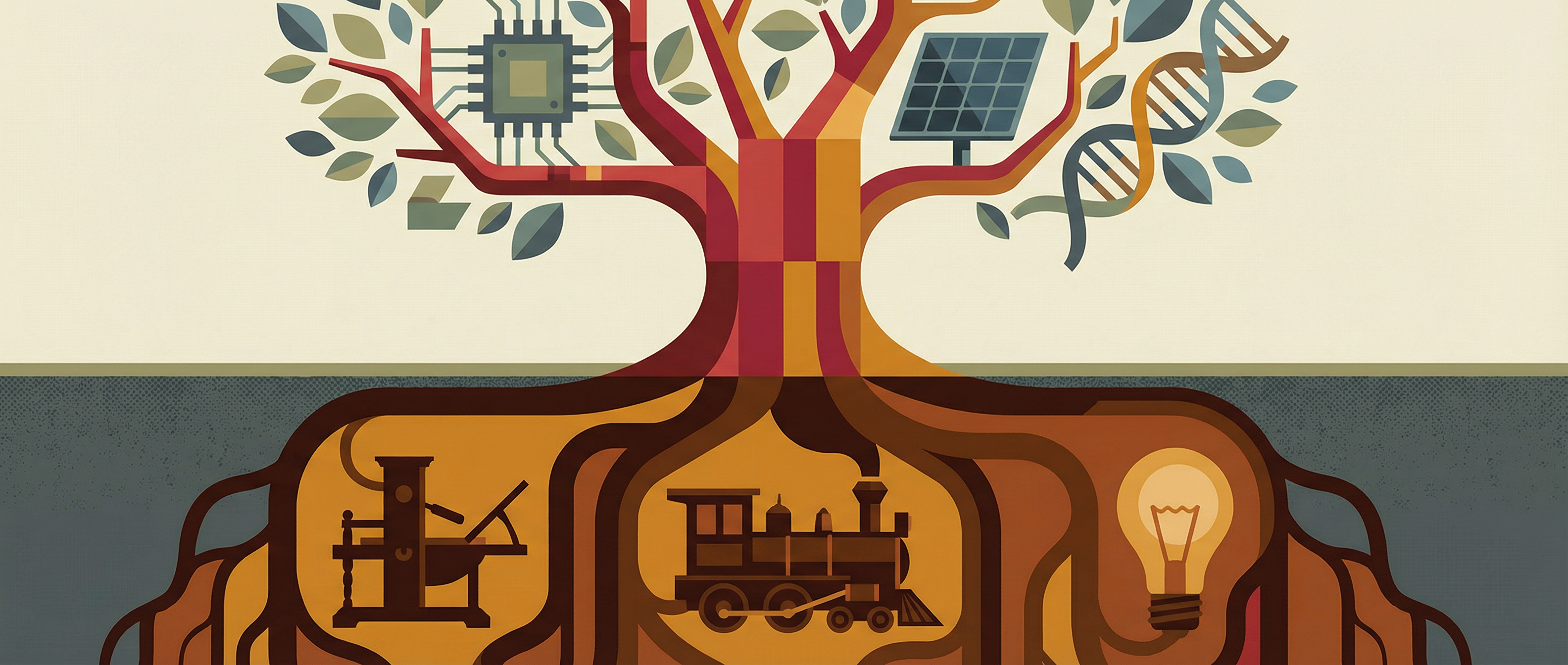
By the 1830s, none of the ingredients were new. The steam engine had existed in some form since Thomas Newcomen’s crude contraption of 1712. Iron-smelting was ancient. The engineering disciplines that built canals and bridges were well established. Each technology, taken alone, was interesting but familiar. Then George Stephenson’s Rocket proved in 1829 that steam could move itself along iron rails — and within two decades, railways had restructured property values across Britain, created suburbs, enabled national newspapers, standardised time zones, and invented the modern corporation. The railway companies were among the first large publicly traded firms in history (Rolt, 1960).
Nobody predicted any of this. The individual technologies were understood; the convergence was not.
This is the pattern that matters. The telegraph convinced the Victorians they had reached the summit of human communication — so thoroughly that the chief engineer of the British Post Office reportedly dismissed Alexander Graham Bell’s telephone in 1876 on the grounds that Britain had “plenty of messenger boys.” A century later, internet pioneers confidently predicted that global connectivity would bring world peace. Individual technologies invite hubris. Convergences deliver humility.
We are now in another such moment. Not one or two, but at least eight platform technologies are maturing simultaneously — artificial intelligence, robotics, quantum computing, biotechnology, genomics, nanotechnology, brain-computer interfaces, and space technology — and they are beginning to fuse. History suggests that the consequences will be far stranger, far larger, and far less predictable than any of us imagine.
What Makes a Platform Technology
A platform technology is not a product. It is a foundation upon which entire industries, social structures, and ways of life are built. Five examples from the past two centuries illustrate the point: electricity, the automobile, the telephone, the computer, and the birth control pill.
The first four are obvious enough. Electricity powered homes, then factories, then cities, then the information age. The automobile remade transport, commerce, and urban planning. The telephone collapsed distance. The computer transformed every industry it touched and eventually spawned the internet.
But consider the birth control pill — approved in 1960, a simple oral tablet. It severed the link between sex and procreation for the first time in human history. Within a decade, female workforce participation surged, the average age of marriage rose, family sizes halved across the Western world, and universities filled with women. The entire social contract between the sexes was rewritten by a technology small enough to sit on a fingernail (Goldin, 2006). A platform technology does not merely create products. It reorganises society.
What distinguishes platform technologies from ordinary innovations is their combinatorial power. Electricity alone was useful; electricity combined with the electric motor and mass production gave Henry Ford his assembly line. The internet alone was a curiosity for academics; the internet combined with the smartphone and GPS gave the world Uber, Deliveroo, and the gig economy. The combination is always more transformative than the sum.
Today, a new generation of platform technologies is not merely emerging — it is converging. And convergence, as the railway age demonstrated, is where civilisational transformation begins.
The New Wave: Three Convergence Clusters
Rather than catalogue each technology in isolation — a temptation that produces encyclopaedia entries, not insight — it is more illuminating to examine how these technologies reinforce one another. Three clusters of convergence are already visible.
Intelligence and Machines
Artificial intelligence is to the twenty-first century what electricity was to the nineteenth: a general-purpose capability that amplifies everything it touches. AI is already transforming healthcare diagnostics, drug discovery, logistics, creative industries, and scientific research. But AI alone is software. It needs a body, and it needs more computational power than classical architectures can sustainably provide.
Robotics gives AI a body. Companies such as Figure.ai, Tesla with Optimus, and Boston Dynamics are building humanoid robots designed to operate in environments built for humans — factories, warehouses, homes, hospitals. The feedback loop is striking: AI makes robots more capable, robots generate vast quantities of real-world training data, and that data makes AI smarter. Quantum computing completes the triangle by promising to solve the optimisation and simulation problems that defeat classical machines — from protein folding to materials design to the training of ever-larger neural networks.
Platform Technology Adoption Timelines
Time from invention to mass adoption is accelerating dramatically — AI assistants reached 50 million users in under six months
Source: Various technology adoption studies; Stanford HAI AI Index, 2024
The speed of this convergence is itself unprecedented. It took electricity 46 years to reach 50 million users. The telephone took 75. AI assistants achieved it in under six months (Stanford HAI AI Index, 2024). The adoption curve is not merely steeper than previous revolutions; it is a different shape entirely.
Biology and Information
The Human Genome Project cost roughly $3 billion and took thirteen years, completing in 2003. Today, a full human genome can be sequenced for under $200 in a matter of hours (NHGRI, 2024). That cost collapse — driven by advances in computing, sensors, and materials science — has blown open the door to personalised medicine, gene therapy, and the serious pursuit of radical longevity.
This is where convergence becomes vivid. Gene editing tools such as CRISPR allow precise modifications to DNA, but interpreting the consequences of those edits across three billion base pairs requires artificial intelligence. Delivering therapies to specific cells — bypassing the blunt-instrument approach of traditional medicine — requires nanotechnology: engineered nanoparticles that can target cancerous tissue while leaving healthy cells untouched. Brain-computer interfaces, pioneered by Neuralink and Synchron, add a further dimension by connecting the brain directly to external information systems, with applications ranging from restoring movement to paralysed patients to enhancing cognitive function.
The convergence pattern: AI interprets genomes, nanotech delivers therapies, BCIs monitor and interface with neural tissue. Companies such as Calico, Altos Labs, and Unity Biotechnology are attacking ageing itself as an engineering problem. The prize — a healthy lifespan of 150 years — would carry social implications arguably greater than the birth control pill: the wholesale rethinking of careers, pensions, family structures, and the very rhythm of human life.
Earth and Space
The Space Shuttle cost approximately $54,500 per kilogram to reach orbit. SpaceX’s Falcon 9 has brought that below $2,700. Starship, currently in testing, targets under $100 per kilogram — comparable to intercontinental airfreight (Jones, 2024). That single cost collapse opens a cascade of possibilities that would have seemed fantastical a generation ago: orbital manufacturing, asteroid mining, and space-based research facilities where genetic engineering and advanced materials science can proceed beyond terrestrial regulatory constraints.
Vertical farming is the linchpin for off-Earth settlement. Controlled-environment agriculture can grow wheat using 25 times less land and salads using 250 times less land than conventional outdoor farming, while consuming roughly 5 per cent of the water and 7.5 times less fertiliser (Fischer Farms data). AI and robotics make these facilities increasingly autonomous. The feedback loop is elegant: cheap access to space creates demand for self-sustaining habitats, which drives vertical farming and robotics innovation, which feeds back into expanded space capability.
Earth benefits directly. As vertical farming scales from leafy greens and herbs to staple crops — rice, wheat, soy, peas — it offers a route to food production that is local, climate-independent, and dramatically less land-intensive. Marginal farmland can be rewilded. Supply chains shortened. Nations can grow food security alongside food.
The Great Cost Collapse
Multiple platform technology costs are plummeting simultaneously — when this happens, convergence follows
Source: NHGRI (genome); IRENA (solar); Stanford HAI (compute); NASA / SpaceX (launch)
The Great Accelerant: Collapsing Costs
Convergence is not an abstract forecast. It is happening now because the cost barriers across multiple platform technologies are collapsing simultaneously. The cost of sequencing a genome has fallen by a factor of fifteen million since 2001. Solar energy is over a thousand times cheaper per watt than in the late 1970s. The cost of computing power per gigaflop has dropped from tens of thousands of dollars in the 1980s to fractions of a penny. Launch costs to orbit have fallen by an order of magnitude in a single decade and are poised to fall further still (NHGRI, 2024; IRENA, 2024; Stanford HAI, 2024; SpaceX, 2024).
When costs collapse across multiple domains at once, the technologies start combining. This is precisely what happened with steam, iron, and engineering in the 1830s: each had been improving for decades, but only when all three crossed critical cost and capability thresholds did the railway emerge. We are crossing those thresholds now — in AI, biotech, energy, computing, and space access — all within the same generation.
Where the Money Is Going: VC Investment in Platform Technologies
Capital is pouring into converging technologies at accelerating rates, with AI surging dramatically since 2020
Source: PitchBook; CB Insights; Stanford HAI AI Index, 2024
Global venture capital confirms the pattern. Investment in AI alone surged from roughly $40 billion in 2019 to over $100 billion by 2024. Biotech, space technology, and robotics are following similar curves. The money is not flowing into these sectors independently; it is flowing into the intersections — AI-driven drug discovery, autonomous space systems, robotic surgery guided by neural interfaces (PitchBook, 2024; CB Insights, 2024).
Where This Goes
The next decade will see AI reshape white-collar work as fundamentally as mechanisation reshaped manual labour two centuries ago. Humanoid robots will enter logistics, elder care, and manufacturing at scale. Vertical farming will advance beyond leafy greens to staple crops, driven by plummeting LED and energy costs. Quantum computing will transition from laboratory curiosity to practical tool in drug discovery, cryptography, and financial modelling. The first serious longevity therapies — gene-based interventions targeting specific ageing mechanisms — will enter clinical trials.
By mid-century, historical precedent suggests the convergence will have produced entirely new industries we cannot currently name — just as the fusion of electricity, telecommunications, and computing produced “the internet,” a category that would have meant nothing in 1950. Longevity therapies will begin extending healthspans materially, forcing societies to rethink retirement, education, and the structure of working life. Space-based manufacturing and mining will become economically significant. The regulatory divergence between Earth and space will widen, with orbital settlements serving as testbeds for technologies too controversial for terrestrial deployment — advanced genetic modification, autonomous AI systems, experimental materials.
Over the longer arc, the pattern from history is clear: every platform convergence has reshaped not just economies but the basic categories through which people understand their lives. The railway age created “commuting,” “tourism,” “national identity,” and “standardised time” — concepts that literally did not exist before the 1840s. The electricity-and-automobile convergence created “suburbia,” “the weekend,” and “mass entertainment.” The internet convergence created “social media,” “the gig economy,” and “remote work.” Each time, the new categories seemed obvious in hindsight but were invisible in advance. The coming convergence will do the same. We shall invent new words for experiences, relationships, and social structures that do not yet exist — shaped by intelligence that exceeds human capability, bodies that last a century and a half, and settlements beyond Earth.
Conclusion
Every previous technological convergence transformed not merely what people could do but how they understood themselves. Britons who lived through the railway age did not just travel faster — they began to think differently about distance, about time, about what it meant to be part of a nation rather than a parish. People who lived through electrification did not just get brighter evenings — they reimagined the shape of a day, the meaning of work, and the possibility of living miles from where they laboured.
The convergence now under way — intelligence that designs and improves itself, biological engineering that may extend healthy life beyond a century, the opening of a new frontier beyond Earth — will reshape not just our economies but our understanding of what it means to be human. The technologies are not speculative. The cost curves have already collapsed. The capital is already flowing. The question is no longer whether convergence will happen, but how quickly and to whose benefit.
Whether that prospect excites or unsettles you may depend on how much faith you place in the adaptability of individuals and communities versus the management capacity of institutions and bureaucracies. History’s verdict is rather consistent on this point: the adaptable thrive, the rigid are broken, and the technologies that promised to be servants have a persistent habit of becoming masters.
The only real question is whether we shall be among those who shape this convergence — or merely those who are shaped by it.