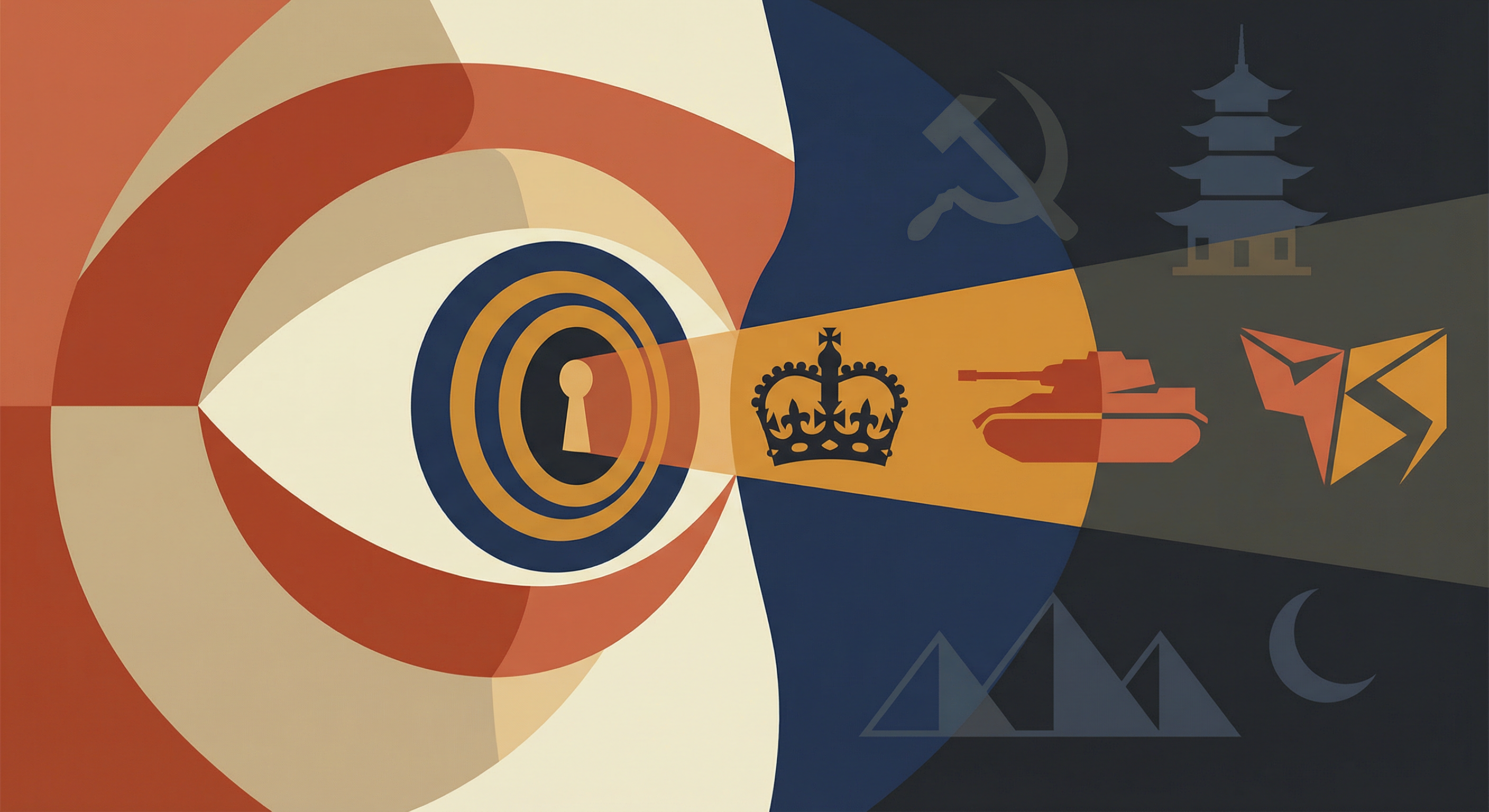
Consider two tax inspectors. The first, in Copenhagen, discovers that she has been undercharged by five hundred kroner on her own tax return. She could say nothing; nobody would ever notice. Instead she reports the error, pays the difference, and sleeps soundly. The second, in a city we shall diplomatically leave unnamed, accepts a cash envelope from a businessman in a restaurant. He does so cheerfully, because everyone at his level does, nobody of consequence is watching, and the businessman will mention it to no one who matters. If a journalist filmed the exchange, the inspector would be mortified — not because the act was wrong, but because it was seen.
In a guilt culture, you feel bad when you break the rules. In a shame culture, you feel bad when you get caught. The difference sounds like a joke, but it has built legal systems, destroyed empires, and continues to make international business negotiations go spectacularly wrong approximately once a week.
This distinction — between the invisible judge of conscience and the ever-watchful eye of the crowd — is one of the most powerful and least understood fault lines in human civilisation. It shapes how societies handle corruption, enforce contracts, pursue scientific truth, and apologise when things go wrong. And when societies that run on different operating systems sit down at the same table, the results range from comic misunderstanding to structural incompatibility.
The Invisible Judge vs. The Eye of the Crowd
The vocabulary for this distinction was given to the English-speaking world by the anthropologist Ruth Benedict in 1946. Working for the United States Office of War Information during the Second World War, Benedict was tasked with explaining Japan to Americans — a culture so alien to Washington that officials could not predict whether the Japanese would fight to the last man or surrender overnight. She never visited Japan. She read its literature, interviewed Japanese-Americans in internment camps, and produced The Chrysanthemum and the Sword, a book that became one of the most influential works of cultural anthropology ever published.
Benedict’s central insight was that Japanese and American societies enforced good behaviour through fundamentally different mechanisms. American society, she argued, was a guilt culture: behaviour was regulated by an internalised sense of right and wrong — a conscience, an invisible judge — that operated regardless of whether anyone was watching. You did the right thing because you knew it was right, and you felt guilty when you failed. Confession could relieve guilt. Atonement was possible. The standard was internal.
Japanese society, by contrast, was a shame culture: behaviour was regulated by the judgement of others. You did the right thing because failing to do so would bring shame — loss of face, ridicule, exclusion from the group. The standard was external. Shame could not be relieved by private confession; it persisted as long as the transgression was known, or could be imagined as known, by others. “True shame cultures,” Benedict wrote, “rely on external sanctions for good behaviour, not, as true guilt cultures do, on an internalized conviction of sin”.
The distinction has been criticised, refined, and complicated in the eight decades since. No society is purely one or the other. The philosopher Bernard Williams argued in Shame and Necessity (1993) that the ancient Greeks — often cited as a shame culture — had a more sophisticated relationship with shame than Benedict’s binary allowed, and that shame could itself be internalised. Cross-cultural psychologists such as June Price Tangney have shown that guilt and shame coexist within individuals and cultures, and that the relationship between cultural orientation and emotional experience is more nuanced than a simple dichotomy. Geert Hofstede’s cultural dimensions framework, particularly the individualism–collectivism axis, correlates loosely with the guilt–shame distinction but is not identical to it.
None of this, however, has made the distinction useless. It remains widely employed in cross-cultural management, diplomacy, and political economy — not because it is a perfect taxonomy, but because it captures something real about how different traditions enforce cooperation. The question is not whether guilt cultures and shame cultures exist in their pure form. They do not. The question is whether the dominant mechanism — internal conscience or external judgement — shapes measurable outcomes. The data suggests it does.
Who Lives Where?
Any attempt to classify the world’s societies along a guilt–shame spectrum must begin with caveats. Within every country there is variation: urban and rural, educated and traditional, young and old. A Tokyo financier and a farmer in Akita prefecture do not experience shame identically. A Swedish entrepreneur and a pensioner in Malmö may not feel guilt about the same things. What follows is a scholarly heuristic — the kind used routinely in cross-cultural management and international development — not a stamp on a passport.
Guilt-dominant societies cluster in Western and Northern Europe, North America, Australia, and New Zealand. The common thread is the inheritance of Christianity — particularly its emphasis on individual sin, conscience, confession, and atonement — reinforced by Enlightenment universalism and the legal traditions that followed. Nordic and Germanic Europe are the strongest examples: Denmark, Sweden, Norway, Finland, Germany, the Netherlands, and Switzerland consistently score highest on measures of rule of law, institutional trust, and (not coincidentally) Hofstede’s individualism index. The Protestant tradition, with its emphasis on the individual’s direct relationship with God and personal moral accountability, is a recurring theme in the literature on guilt cultures — Max Weber’s Protestant Ethic thesis, whatever its limitations, captures something real about the internalisation of moral standards.
Shame-dominant societies are found across much of East Asia, Southeast Asia, and parts of the Middle East and Mediterranean. Japan remains the canonical example — Benedict’s original subject — where the concept of haji (shame, disgrace) functions as a primary social regulator. China’s mianzi (face) and lian (moral character as perceived by the community) operate similarly: to “lose face” is to suffer a social sanction that is both external and devastating. South Korea’s chemyon (social face) and the broader Confucian emphasis on propriety, hierarchy, and collective harmony all privilege the judgement of the group over the verdict of private conscience. In parts of the Middle East, honour cultures — where family and clan reputation is paramount — share structural features with shame cultures: the transgression is not the act itself but the public knowledge of it.
Hofstede Individualism Score by Country (Proxy for Guilt vs. Shame Orientation)
Higher individualism correlates loosely with guilt-dominant norms; lower with shame/collectivist norms.
Source: Hofstede, Culture's Consequences (2001); Hofstede Insights country comparison tool
Mixed or transitional societies include much of Latin America, Southern Europe (Italy, Spain, Greece), Turkey, India, and Russia — where kinship-based shame norms coexist with universalising religious or legal traditions (Catholicism, Orthodoxy, Hinduism, Islam) that introduce elements of internalised guilt. India is particularly complex: the caste system enforces shame-like external sanctions, while Hindu and Buddhist philosophical traditions emphasise karma and internal moral accounting. Urban, educated, globalised populations in these countries often lean more guilt-dominant; rural and traditional communities lean more shame-dominant. The direction of travel, in most cases, is toward hybrid forms — but the pace varies enormously.
What the Data Shows
If guilt-dominant societies enforce good behaviour through internalised norms — doing the right thing even when nobody is watching — and shame-dominant societies enforce it through the fear of being seen, then there is a testable prediction: guilt-dominant societies should exhibit lower corruption and stronger rule of law, because the incentive structure does not depend on surveillance. The data, with appropriate caveats, supports this.
Corruption Perceptions Index by Culture Type
Average CPI score (0 = highly corrupt, 100 = very clean) for guilt-dominant, shame-dominant, and mixed societies.
Source: Transparency International, Corruption Perceptions Index 2024; culture classification per Benedict/Hofstede
Transparency International’s Corruption Perceptions Index (CPI) ranks 180 countries on a scale of 0 (highly corrupt) to 100 (very clean). The 2024 index places Denmark (90), Finland (87), New Zealand (83), Norway (84), and Sweden (82) at the top — all guilt-dominant, high-individualism societies. At the bottom sit South Sudan (8), Somalia (11), Syria (13), and Venezuela (14) — societies where neither guilt nor shame norms function effectively due to state collapse. In the broad middle, a pattern emerges: shame-dominant societies — China (45), Saudi Arabia (40), Indonesia (34), Pakistan (24) — tend to cluster below the global average of 43, while guilt-dominant societies cluster above it. The mean CPI score for the guilt-dominant group (selecting the 15 most commonly classified guilt-dominant nations) is approximately 78. For the shame-dominant group (equivalent selection), it is approximately 38. For the mixed group, it sits around 48.
The logic is straightforward. Where the primary sanction for wrongdoing is shame — being seen, being caught, losing face — the rational strategy is to avoid being seen rather than to avoid doing wrong. Corruption can thrive as long as it is hidden, shared among in-groups, or conducted within relationships where exposure is unlikely. Where the primary sanction is guilt — an internalised conviction that the act itself is wrong, regardless of witnesses — the incentive structure shifts. The invisible judge does not take bribes. You cannot negotiate with your own conscience the way you can manage your reputation.
Global Innovation Index Score by Culture Type
Mean GII score for guilt-dominant, shame-dominant, and mixed societies. Higher = more innovative.
Source: WIPO, Global Innovation Index 2025; culture classification per Benedict/Hofstede
Innovation tells a similar, if more complex, story. The World Intellectual Property Organisation’s Global Innovation Index (GII) ranks nations on innovation inputs and outputs. The 2025 GII places Switzerland (1st), Sweden (2nd), the United States (3rd), and the United Kingdom (5th) at the top — all guilt-dominant. South Korea (4th) and Singapore (5th) are notable exceptions from the shame-dominant or mixed categories, and both are instructive: they have adopted institutional frameworks (patent law, independent courts, research funding structures) that are essentially guilt-culture transplants, grafted onto societies with strong shame traditions. Japan (13th), another shame-dominant society with transplanted guilt-culture institutions, similarly performs well. The pattern is not that shame-dominant societies cannot innovate — they manifestly can — but that their innovation tends to accelerate when they adopt guilt-culture institutional architecture: transparent peer review, independent courts, meritocratic funding, and whistleblower protections that reward truth-telling regardless of social cost.
Scientific truth-seeking is perhaps the deepest expression of the guilt-culture instinct. The scientific method presumes that truth is independent of the observer, that evidence outweighs authority, and that being wrong is not a disgrace but a step toward being less wrong. These are guilt-culture assumptions: the standard is internal (the evidence), not external (what the professor or the government or the community thinks). In shame-dominant academic cultures, contradicting a senior colleague in public can be a career-ending act of face-destruction — not because the senior colleague is necessarily right, but because the social cost of public correction is too high. This does not make shame-dominant societies incapable of science. It does mean that the institutional conditions for disruptive, paradigm-shifting discovery — the kind that requires someone to stand up and say “the emperor has no clothes” — are harder to create and sustain when the primary sanction for deviance is social rather than moral.
A caveat that is analytically essential. Correlation is not causation. The guilt-dominant societies that score highest on CPI and GII are also, overwhelmingly, wealthy, post-industrial democracies with strong institutions, high education levels, and centuries of legal development. Colonial history, geography, natural resources, and sheer luck all play a role. The guilt–shame lens is one explanatory dimension among several. It is not the only one. But it is a dimension that most accounts of institutional quality overlook entirely — and the consistency of the correlation, across very different regions and histories, suggests it is not accidental.
Why They Clash
When a guilt-culture firm negotiates a contract with a shame-culture firm, something subtle and consequential happens. The guilt-culture negotiator treats the signed contract as the relationship: the document is the commitment, the terms are the terms, and compliance is expected because both parties have internalised the obligation. The shame-culture negotiator may treat the contract as one element of a broader relationship: the document matters, but so does the ongoing social bond, the mutual obligation, the face of both parties. If circumstances change, renegotiation is not betrayal — it is adaptation within a relationship. To the guilt-culture observer, this looks like breaking your word. To the shame-culture observer, rigid adherence to a document when the relationship has evolved looks like missing the point entirely.
The same asymmetry appears in apology and responsibility. In guilt cultures, a public apology — “I was wrong, I take responsibility” — is the gold standard. Confession relieves guilt. The individual admits fault and the community respects the admission. In shame cultures, a public apology can be catastrophic: it does not relieve shame but creates it, permanently marking the individual or institution as flawed in the eyes of the community. The rational response is to save face — to offer indirect acknowledgement, to redistribute responsibility, to restore harmony without explicit admission of fault. To the guilt-culture observer, this looks like evasion. To the shame-culture participant, the guilt-culture demand for public confession looks like a deliberate attempt to destroy someone’s social standing — a hostile act disguised as moral principle.
The implications extend far beyond individual negotiations. The institutional architecture of the post-1945 international order — the United Nations, the World Trade Organisation, the International Criminal Court, the EU’s regulatory framework — is built overwhelmingly on guilt-culture assumptions. Universal rules. Transparent processes. Accountability to abstract principles rather than to relationships. Whistleblower protections. Freedom of information. The presumption that the truth should be publicly stated regardless of social consequence. These are not neutral, culture-free principles. They are the institutional expression of a specific moral tradition — one that prizes the invisible judge over the eye of the crowd. When states and firms from shame-dominant traditions engage with these institutions, they often comply formally while navigating informally by relationship, face, and mutual obligation. The result is not necessarily dishonesty — it is a different kind of honesty, operating by different rules, within institutions designed for a different moral logic.
This is what makes the incompatibility structural rather than personal. It is not that individuals from shame cultures are less moral, or that individuals from guilt cultures are less socially attuned. It is that the two systems produce different definitions of what “doing the right thing” means, different incentive structures for enforcement, and different expectations about transparency, apology, and trust. When they meet in a globalised world — in trade negotiations, in multinational corporations, in immigration, in diplomacy — the signals do not translate automatically. Each side reads the other’s behaviour through its own moral grammar and finds it wanting.
The Same Courtroom
Two ways of keeping people honest. Two different kinds of judge.
The invisible judge — conscience, guilt, internalised conviction — produces societies that tend to score higher on corruption indices, stronger on rule of law, and more hospitable to disruptive scientific truth-seeking. The eye of the crowd — shame, face, collective judgement — produces societies with powerful social cohesion, deep relationship-based trust, and a capacity for rapid collective mobilisation that guilt-culture individualism often struggles to match. Japan’s post-war reconstruction, South Korea’s industrialisation, and China’s manufacturing dominance were all achieved within shame-culture frameworks that leveraged collective discipline and hierarchical coordination in ways that guilt-culture societies, with their emphasis on individual conscience and institutional process, find difficult to replicate.
Neither system is superior. Both produce cooperation and both produce cruelty. Guilt cultures can generate paralysing self-doubt, moral narcissism, and a tendency to elevate individual conscience above collective welfare — the dark side of the invisible judge is the person who would rather be right than effective. Shame cultures can produce suffocating conformity, the suppression of dissent, and a willingness to tolerate private wrongdoing as long as public appearances are maintained — the dark side of the crowd’s eye is the culture that punishes the whistleblower more harshly than the wrongdoer.
The twenty-first century has put them in the same courtroom. Global trade, multinational institutions, mass migration, and the internet have made it impossible for guilt cultures and shame cultures to operate in separate jurisdictions. They must negotiate with each other, build institutions together, and trust each other — using moral grammars that do not share the same vocabulary. Whether they can learn to translate remains, for now, an open question. The invisible judge and the eye of the crowd have kept very different kinds of order for a very long time. The question is not which is right. The question is whether they can sit in the same courtroom and agree on what counts as evidence.