In January 2018, the city of Cape Town began publishing a countdown. Not to a festival or a sporting event, but to the date on which the taps would be turned off. “Day Zero,” the city called it — the point at which four million residents would queue at military-guarded distribution points to collect a daily ration of twenty-five litres of water. The queues would be long. The soldiers would be armed. The ration — roughly one toilet flush, one brief shower, and whatever was left over for drinking and cooking — would be non-negotiable.
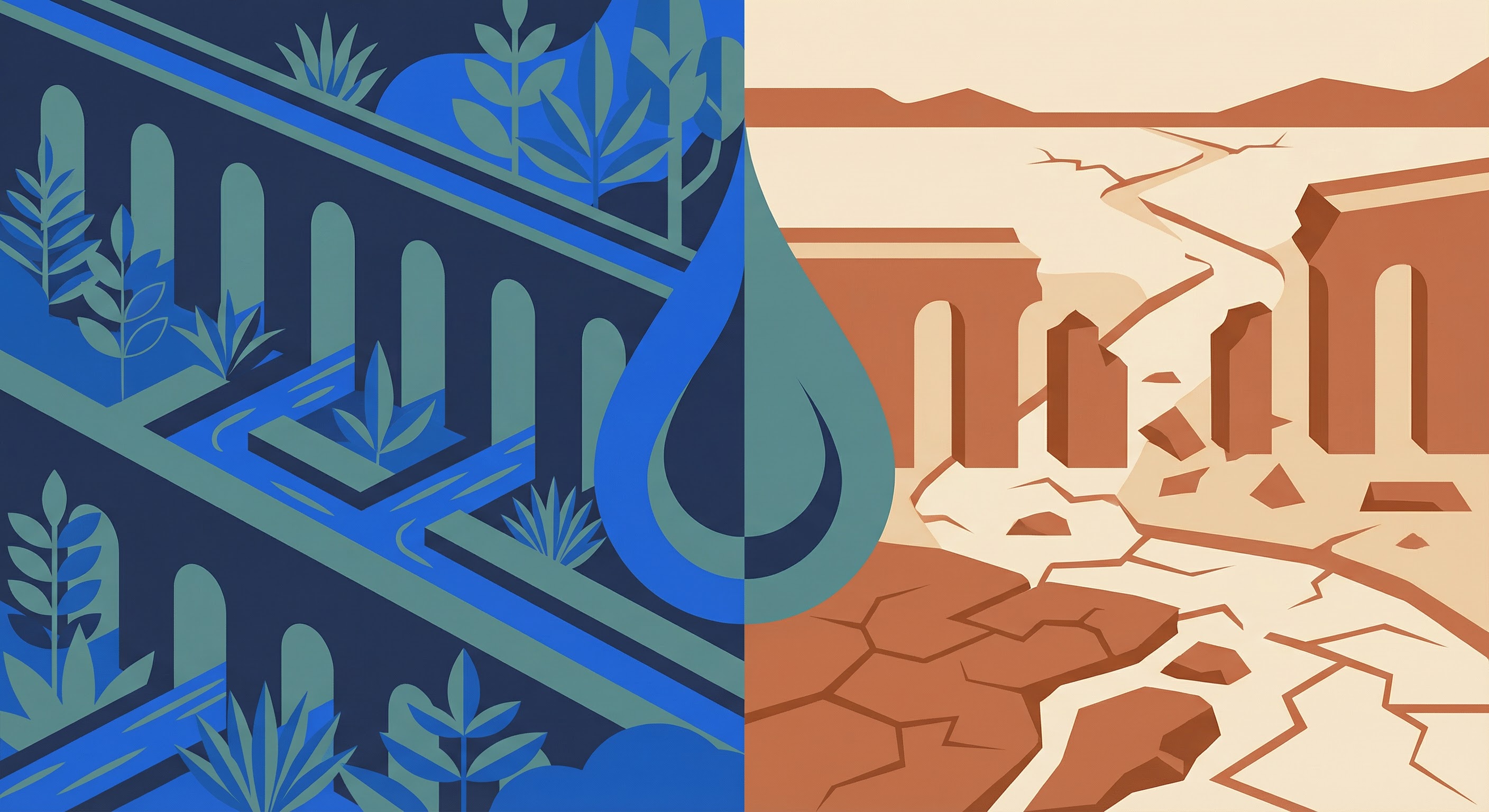
Day Zero did not arrive. Emergency drilling, severe restrictions, and the merciful return of winter rains pulled Cape Town back from the edge. But the crisis revealed something that most cities would rather not contemplate: the water flowing from your tap is not a law of nature. It is an engineering arrangement, maintained at considerable expense, dependent on rainfall patterns, aquifer levels, and political decisions made decades ago. For Chennai, São Paulo, Mexico City, Jakarta, and Cairo, that arrangement is becoming less reliable every year. The Romans built aqueducts that still function after two thousand years. We built cities in deserts and act surprised when the taps run dry. One suspects the Romans would have had opinions about this.
Water is the one resource for which there is no substitute. You can replace oil with solar, coal with gas, copper wire with fibre optics. You cannot replace water with anything. Every major civilisation in human history was built on the mastery of water — its capture, storage, distribution, and management. And every civilisation that lost control of its water supply did not merely decline. It collapsed. The modern world, with its dams, pipelines, and desalination plants, has convinced itself that it has transcended this ancient dependency. The historical record suggests otherwise.
The Hydraulic Civilisations
In 1957, the historian Karl Wittfogel published Oriental Despotism, in which he proposed what became known as the “hydraulic hypothesis.” His argument was sweeping and, in places, deliberately provocative: large-scale irrigation requires centralised coordination; coordination requires bureaucracy; bureaucracy requires the state. Water management, Wittfogel contended, did not merely sustain early civilisations. It created them. The thesis has been criticised — Wittfogel’s political conclusions about Asian governance have aged poorly — but his central insight remains one of the most powerful ideas in historical sociology. The earliest states arose in arid or semi-arid regions where agriculture was impossible without collective water management. The state was invented, in no small part, to manage water.
Mesopotamia — the name itself means “between the rivers” — is the founding case. The Tigris and Euphrates are unpredictable: spring floods can be catastrophic, summers bring drought, and the rivers shift course over decades. Farming in this landscape required canals to distribute floodwater, levees to contain it, and reservoirs to store it. By the third millennium BC, the city-state of Girsu alone maintained canals irrigating over four thousand hectares. The administrative demands of this infrastructure — who digs, who maintains, who receives water, who pays — produced the world’s earliest written records. Cuneiform was not invented for poetry or philosophy. It was invented for water accounting. The wedge-shaped marks pressed into clay tablets at Uruk around 3200 BC record grain allocations, canal maintenance obligations, and tax assessments. Writing, bureaucracy, and the state emerged together, and they emerged because someone had to manage the canals.
Egypt’s relationship with water was simpler in mechanism but no less foundational. The Nile flooded predictably — too low meant famine, too high meant destruction, and just right meant abundance. The Nilometer gauges along the river determined not merely planting schedules but tax assessments: a good flood meant higher taxes, because there would be more grain to tax. The pharaoh’s legitimacy rested substantially on his ability to mediate between his people and the river. When the floods failed, as they periodically did, dynasties fell. The Indus Valley civilisation, at Mohenjo-daro and Harappa, built covered street drains and civic sewerage systems that European cities would not match until the nineteenth century — four thousand years later. China’s Grand Canal, completed in stages over two millennia, stretched nearly 1,800 kilometres to link the Yangtze and the Yellow River, holding the empire together through hydraulic infrastructure. When sections silted up, famine and rebellion followed with the predictability of a hydrological cycle.
The pattern across all four cradles is identical. Water demanded collective action. Collective action demanded hierarchy. Hierarchy demanded records. Records demanded literacy. Literacy demanded administration. The state — with its taxes, laws, and coercive power — was not an abstract political invention. It was a practical response to the problem of distributing water in a dry landscape.
When the Water Stopped
If the mastery of water built civilisations, its loss destroyed them — and the destruction was comprehensive.
The Akkadian Empire is the first documented case. Under Sargon of Akkad, around 2334 BC, Mesopotamia was unified into what is generally considered the world’s first empire. It lasted barely a century. Around 2200 BC, the empire disintegrated. The archaeological evidence from Tell Leilan, in modern Syria, is stark: a thriving city was abruptly abandoned, and wind-blown dust accumulated over the ruins, undisturbed for three centuries. For decades, the cause was debated. Then the climate scientists arrived. Peter deMenocal, working with sediment cores from the Gulf of Oman, found a sharp spike in wind-carried dust — a proxy for arid conditions — beginning around 2200 BC and lasting roughly three hundred years. Harvey Weiss’s excavations at Tell Leilan confirmed the picture: the rainfall that sustained the empire’s northern breadbasket simply stopped. The canals dried up. The grain stopped flowing. The first empire was undone not by invasion or civil war, but by a change in rainfall patterns that no Akkadian king could have predicted or prevented.
The Classic Maya collapse of the ninth century AD followed a script that would have been familiar to the Akkadians. At their height, the Maya of the southern lowlands supported perhaps ten to fifteen million people — a remarkable density in a tropical landscape with no permanent rivers. They achieved this through an extraordinary system of reservoirs, raised fields, and terraced hillsides. Between roughly 800 and 1000 AD, the great cities of the southern lowlands — Tikal, Copán, Palenque, Calakmul — were abandoned. Population fell by an estimated seventy to ninety per cent. Sediment cores from Lake Chichancanab, analysed by Hodell, Curtis, and Brenner, revealed the most severe drought in seven thousand years, coinciding precisely with the collapse. The Maya had engineered their landscape brilliantly for normal conditions. They had no answer for a multi-decade drought that exceeded the capacity of their reservoirs.
The Khmer Empire tells the same story at larger scale. Angkor, the capital, was the largest pre-industrial city in the world — its urban footprint exceeded modern Los Angeles. It was sustained by the most sophisticated water management system of the medieval world: a network of canals, reservoirs called barays, and carefully graded channels that captured monsoon rains and distributed them across the landscape. By the fourteenth century, the system was deteriorating — siltation, deforestation, and increasingly erratic monsoons degraded the infrastructure that no Khmer government could adequately maintain. When the Thai kingdom of Ayutthaya sacked Angkor in 1431, the water system had already failed. The army merely delivered the final blow to a civilisation that was dying of thirst.
Even the modern world has not been immune. The American Dust Bowl of the 1930s — a combination of severe drought and catastrophic land management on the Great Plains — turned one of the world’s most productive agricultural regions into a wasteland of blowing topsoil and abandoned farms. It triggered the largest peacetime migration in American history. The pattern across five thousand years is consistent: civilisations that lose control of their water supply collapse. There are no exceptions.
The Modern Crisis
The Colorado River supplies water to forty million people across seven American states and Mexico. It no longer reaches the sea — every drop is extracted before it gets there. Lake Mead, the reservoir behind the Hoover Dam, fell to 27% of capacity in 2022; Lake Powell, its upstream partner, to 24%. The Bureau of Reclamation declared the first-ever federal water shortage on the Colorado in 2021. The seven states that share the river operate under a compact negotiated in 1922, when the Colorado’s flow was unusually high and the population it served was a fraction of today’s. The compact over-allocated the river from the start. Climate change is now reducing its flow further — snowpack in the Rockies, the river’s primary source, has declined markedly. The compact is a legal fiction maintained by increasingly desperate engineering.
Global Freshwater Withdrawal vs. Renewable Supply (1900–2050)
Humanity is drawing down its water reserves faster than nature can replenish them
Source: FAO AQUASTAT; UN World Water Development Report 2024
The Aral Sea, once the world’s fourth-largest lake, has lost approximately ninety per cent of its volume since 1960. Soviet cotton irrigation diverted the rivers that fed it, turning a vast inland sea into a toxic, wind-scoured dustbowl. Fishing communities that once sat on the shore are now eighty kilometres from the retreating waterline. The Ogallala Aquifer, which irrigates roughly thirty per cent of American cropland across the Great Plains, is being depleted three to ten times faster than natural recharge. In parts of Kansas and Texas, the water table has dropped more than forty-five metres since the 1950s. Large sections of the aquifer may be functionally exhausted within thirty to fifty years. When it goes, American grain production goes with it.
India pumps more groundwater than the United States and China combined. Over sixty per cent of Indian irrigated agriculture depends on it. NITI Aayog, the government’s policy think tank, warned that twenty-one major Indian cities could effectively run out of groundwater by 2025. Chennai, a city of ten million people, came close to confirming that prediction in June 2019, when reservoirs ran dry and water had to be delivered by train — tanker cars rolling into a city that had simply run out. São Paulo came within twenty days of emptying its main reservoirs in 2015. Mexico City, built on a drained lakebed, is sinking up to thirty centimetres per year as the aquifer beneath it is pumped dry — the city is literally subsiding into the void left by its own water consumption. Jakarta is sinking so fast that Indonesia is building an entirely new capital on Borneo. The World Resources Institute identifies twenty-five countries — home to one quarter of the global population — as facing “extremely high” water stress, meaning they withdraw more than eighty per cent of their renewable supply every year. Among them are some of the world’s most volatile and populous regions: the Middle East, North Africa, and South Asia.
Global Water Stress: The Thirsty World (2025)
A world map of water stress — from the parched Middle East to the water-rich north
Source: WRI Aqueduct 4.0; FAO AQUASTAT
Water Wars and the Hopeful Case
The word “rival” comes from the Latin rivalis — one who shares the same stream. It is not an accident that a word for conflict derives from a word for water.
The Nile is the most consequential flashpoint. Egypt depends on it for virtually all of its freshwater; ninety-seven per cent of Egyptians live within a few kilometres of the river. Ethiopia, the source of roughly eighty-five per cent of the Nile’s water via the Blue Nile, has been filling the Grand Ethiopian Renaissance Dam since 2020. Egypt views the dam as an existential threat; Ethiopia views it as an existential necessity — the dam will generate 6,000 megawatts for a country where half the population lacks reliable electricity. Negotiations have stalled repeatedly. Egyptian officials have made barely veiled military threats. The Indus Waters Treaty between India and Pakistan has survived three wars — it endured because both nations saw bilateral value in it, not because any third party enforced it. India’s upstream hydroelectric projects and Prime Minister Modi’s remark that “blood and water cannot flow together” suggest it is now under unprecedented strain, as changing national interests expose the limits of arrangements that cannot adapt when sovereign priorities diverge. Turkey’s Southeastern Anatolia Project — a massive dam and irrigation scheme — has reduced downstream flow to Iraq and Syria by an estimated forty to eighty per cent. Steven Solomon, in his comprehensive study Water, argues persuasively that scarcity has been a contributing factor in nearly every major regional conflict of the past century. The Syrian civil war was preceded by the worst drought in the Fertile Crescent in nine hundred years, which drove over a million farmers into already overcrowded cities. Water does not cause wars by itself. It makes every other source of conflict worse.
Major Aquifer Depletion: Extraction vs. Recharge Rates
The world's great aquifers are being drained far faster than they refill
Source: USGS; Central Ground Water Board (India); Famiglietti (2014)
The hopeful case has a name: Israel. A country in the Negev Desert, with modest rainfall and a tenfold increase in population since 1948, now produces more freshwater than it consumes. Five desalination plants supply roughly eighty per cent of domestic water; eighty-seven per cent of wastewater is recycled for agriculture; drip irrigation — an Israeli invention — cuts agricultural water use by up to seventy per cent. Singapore’s NEWater system, which purifies wastewater to drinking standard, meets forty per cent of the city-state’s demand and is projected to reach fifty-five per cent by 2060. These are real achievements. They are also expensive, energy-intensive, and dependent on institutional competence that most water-stressed nations do not possess. Saudi Arabia’s desalination plants consume an estimated 1.5 million barrels of oil equivalent per day — burning hydrocarbons to produce the water needed to survive in a climate made harsher by burning hydrocarbons. For the countries where the crisis is most acute — Pakistan, India, Egypt, the nations of the Sahel — the multi-billion-dollar infrastructure required remains far out of reach. Sub-Saharan Africa’s population is projected to double by 2050, in a region where forty per cent of people already lack access to basic drinking water.
The Pattern
Every civilisation that ran out of water collapsed. The Akkadians did not find a technological solution. The Maya did not invent desalination. The Khmer did not adapt in time. The Americans of the Dust Bowl survived only by abandoning the land and starting over elsewhere — an option not available to a planet of eight billion. The question is whether the modern world, with its science, capital, and full awareness of the risk, will be the first civilisation to break the pattern — or the largest to confirm it.
Water Stress by Region: 2025 vs. 2050 (Projected)
The Middle East and North Africa already face extreme stress — South Asia and Southern Europe are catching up
Source: WRI Aqueduct 4.0; UN World Water Development Report 2024
The water is still flowing. The taps are tightening. We have pumped aquifers that took millennia to fill, drained rivers that sustained ecosystems for millions of years, and built cities of tens of millions in places where the natural supply supports a fraction of that population. The bill is coming due, and history is rather clear about what happens when it arrives. Send that to someone who still thinks water is someone else’s problem.