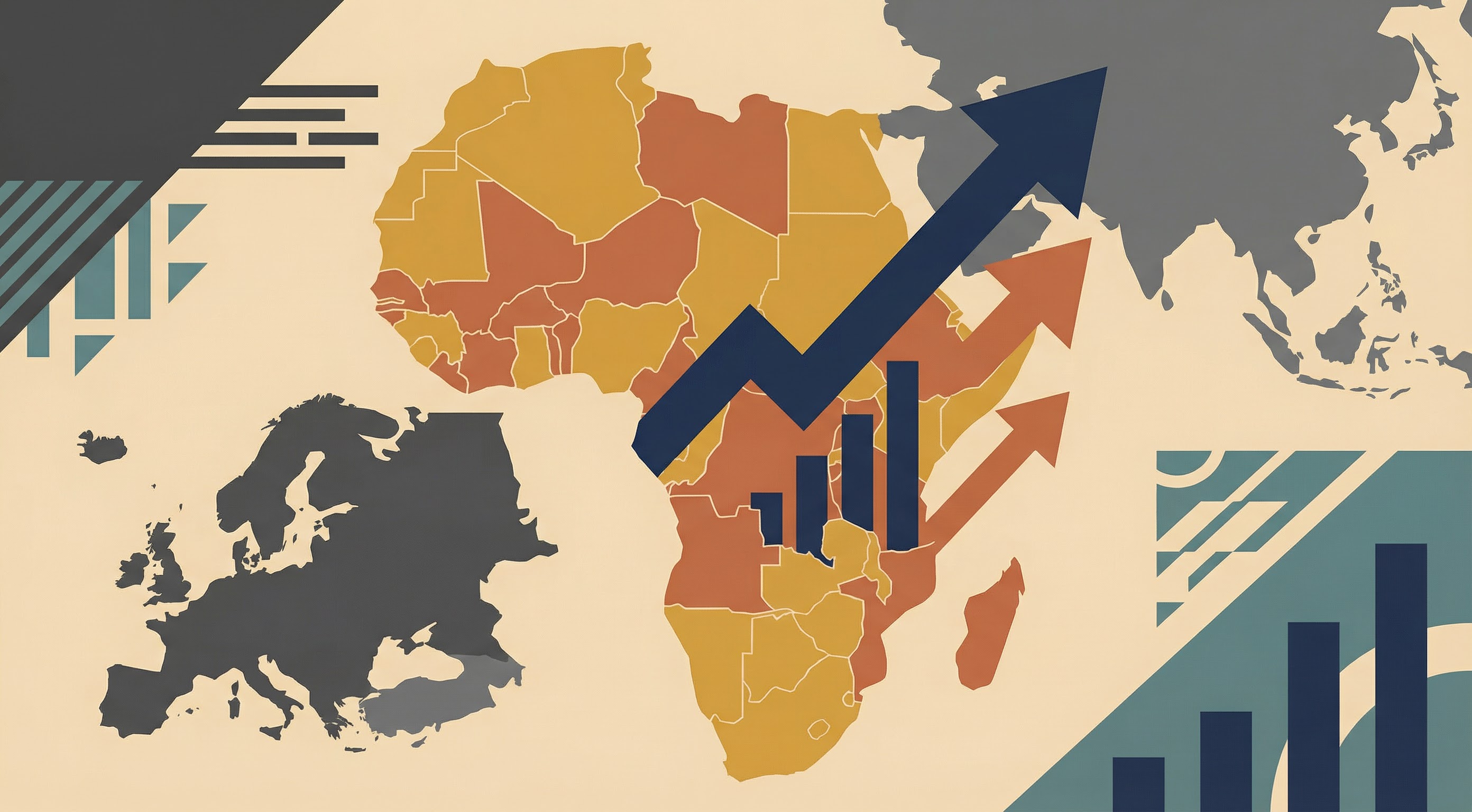
The median age in Niger is 14.5 years. Half the country’s population has not yet reached secondary school. In Japan, the median age is 49.1 — half the population is closer to retirement than to childbirth (UN Population Division, 2024). These two numbers, placed side by side, describe the single most consequential divergence in the modern world. One civilisation is running out of people. Another is producing them at a pace not seen since Europe’s own population explosion in the nineteenth century.
Africa’s population today stands at approximately 1.46 billion. By 2050, the United Nations projects it will reach 2.49 billion. By the century’s end, the medium-variant projection places it at 3.9 billion — though if fertility declines more slowly than expected, the figure could exceed four billion (UN Population Division, 2024). One in three humans alive in 2100 will be African. No single continent has ever constituted so large a share of the global population in recorded history.
Europe, which spent roughly five centuries colonising Africa and extracting its resources, is now discovering that demographics have a rather well-developed sense of irony. The continent that Europe treated as a mine is becoming the continent that Europe needs. The EU’s working-age population is projected to decline by 50 million by 2050 (Eurostat, 2023). Germany alone will need an estimated 400,000 immigrants per year simply to keep its pension system solvent (Institut der deutschen Wirtschaft, 2023). The question is no longer whether Africa will reshape the global order. It is whether the global order will have the wit to notice before the reshaping is complete.
Africa's Youngest Nations: Median Age (2025)
Half the population of Niger is under 14.5 years old — Europe has not seen demographics like this since the medieval period
Source: UN Population Division 2024
This is the story of the largest demographic transformation in human history, and of the power shift it will inevitably produce.
The Numbers
Demographic projections are, as any honest demographer will admit, exercises in structured uncertainty. But the broad trajectory of Africa’s population growth is not uncertain. It is already baked in. The children who will be Africa’s workers, consumers, soldiers, and migrants in 2050 have already been born, or will be born to mothers who have already been born. The demographic momentum is locked.
Continental Population Trajectories (1950–2100)
By 2100, one in three humans will be African — the most dramatic demographic shift in recorded history
Source: UN Population Division, World Population Prospects 2024 (medium variant)
In 1960, sub-Saharan Africa’s population was approximately 227 million — smaller than the United States at the time. By 2000 it had reached 670 million. Today it exceeds 1.2 billion. The growth rate has slowed from its peak of roughly 2.9 per cent per year in the late 1980s to approximately 2.5 per cent today, but because the base population is so much larger, the absolute numbers being added each year are greater than ever (UN Population Division, 2024). Sub-Saharan Africa currently adds roughly 30 million people per year — the equivalent of a new Peru, annually.
The individual country projections are staggering. Nigeria, currently the seventh most populous nation on Earth at approximately 224 million, is projected to reach 375 million by 2050, overtaking the United States to become the world’s third most populous country, behind only India and China (UN Population Division, 2024). The Democratic Republic of the Congo, a nation the size of Western Europe that most Westerners could not locate on a map, will grow from 102 million to an estimated 215 million. Ethiopia will reach 213 million. Tanzania will surpass 130 million. Egypt, already at 112 million and hemmed into a narrow ribbon of habitable land along the Nile, will reach 160 million. By mid-century, Africa will contain at least five nations with populations exceeding 100 million.
Africa's Population Density: Where the Surge Is Concentrated (2025)
Nigeria, DRC, Ethiopia, and East Africa are the engines of the demographic explosion
Source: UN Population Division 2024; World Bank
Fertility rates across the continent are declining, but from a baseline so high that the decline itself produces growth. The total fertility rate for sub-Saharan Africa has fallen from 6.7 children per woman in 1980 to approximately 4.3 today (World Bank, 2024). In East Africa, particularly in Ethiopia, Kenya, and Rwanda, the decline has been sharper — approaching 3.5 in some urban areas. But in the Sahel — Niger, Mali, Chad, Burkina Faso — fertility remains above 6.0. Niger’s rate of 6.7 is the highest in the world. The demographic transition that took Europe roughly 150 years, from high birth and death rates to low birth and death rates, is occurring in Africa in compressed form, but the compression is uneven. Coastal, urbanised, educated Africa is well into the transition. Landlocked, rural, under-served Africa has barely started.
The historian John Iliffe, in his masterful survey Africans: The History of a Continent, argued that Africa’s demographic history has always been defined by the struggle against underpopulation rather than overpopulation (Iliffe, 2007). For most of recorded history, Africa’s challenge was too few people spread across too vast a land mass, making state formation, infrastructure, and economic specialisation extraordinarily difficult. Disease, particularly malaria and trypanosomiasis, kept population densities low. The slave trades — Atlantic, trans-Saharan, and Indian Ocean — extracted an estimated 20 to 30 million people over four centuries, devastating the productive capacity of entire regions. What is happening now is, in the longest view of African history, not an aberration but a correction. Africa is finally, belatedly, filling up.
The question the world must grapple with is not whether this will happen — it is already happening — but what it will mean for the distribution of global economic and political power.
When the Centre of Gravity Shifted Before
The idea that demographics determine destiny is unfashionable in an age that prefers to credit institutions, innovation, and leadership. But the historical record is brutally clear: over the long run, the places with the most people tend to become the places with the most power. Every exception is temporary. Every temporary exception eventually corrects.
For most of the past two millennia, the world’s two largest economies were China and India. This was not because the Chinese and Indians were inherently more industrious or more clever than anyone else. It was because they had the most people. In 1 AD, the Han Dynasty presided over a population of roughly 60 million, the largest organised polity on Earth. India’s various kingdoms and empires collectively governed perhaps 75 million. The Roman Empire, at its height, managed around 60 million across a territory stretching from Britain to Mesopotamia (Maddison, 2007). When Angus Maddison calculated historical GDP shares, China and India together accounted for roughly half the world’s economic output for most of the period between 1 AD and 1800 AD. They did so for the simplest of reasons: they had roughly half the world’s people, and in a pre-industrial economy, output is almost perfectly correlated with population.
The great anomaly of the past two centuries — the period in which a small peninsula on the western edge of Eurasia, containing perhaps 20 per cent of the world’s population, came to control perhaps 80 per cent of the world’s economic output — was made possible by a technological revolution that temporarily severed the link between population and power. The Industrial Revolution, which began in Britain around 1760 and spread across Western Europe and North America over the following century, allowed relatively small populations to produce vastly disproportionate output through mechanisation, fossil fuels, and the systematic application of science to production. Britain, with a population of 10 million in 1800, could outproduce China, with a population of 300 million, because each British worker commanded vastly more energy and capital than each Chinese one.
That anomaly is closing. China’s rise since 1978 is, in the deepest structural sense, simply the reassertion of demographic weight through industrialisation. India’s current trajectory follows the same pattern. The centre of economic gravity, which the McKinsey Global Institute has tracked geographically, sat somewhere in the mid-Atlantic in 1950, reflecting the dominance of Western Europe and North America. By 2025 it has shifted to a point above Turkey. By 2050 it will sit somewhere over the Indian Ocean (Dobbs et al., 2012). The movement is relentless, and it is driven overwhelmingly by the simple arithmetic of where people are.
The Mediterranean was the centre of the ancient world because the civilisations around its shores — Egypt, Mesopotamia, Greece, Rome, Carthage — contained the greatest concentrations of people and productive capacity. The Atlantic became the centre from the sixteenth century onward, as European populations expanded and colonised the Americas. The Pacific has risen since the mid-twentieth century, as Asian populations industrialised. The next shift, which will define the second half of this century, will be towards the Indian Ocean basin and the African continent. Not because anyone wills it, but because that is where the people will be.
The implications are straightforward. A continent of 2.5 billion people in 2050, even at modest levels of per-capita productivity, will constitute an economic bloc of enormous significance. If Africa’s GDP per capita in 2050 matches that of India today — roughly $2,500 — the continent’s total GDP would exceed $6 trillion, larger than Japan’s current economy. If it matches China’s GDP per capita in 2010 — roughly $4,500, a level China achieved when it was still considered a developing country — Africa’s economy would exceed $11 trillion, rivalling the European Union. The numbers are not speculative. They are arithmetic.
The precedent of the United States itself is worth considering. In 1800, the American population was 5.3 million — a rounding error by European standards. By 1900 it was 76 million, and by 1950 it was 152 million. This population surge, fed by both natural increase and mass immigration, was the foundation upon which American economic and military dominance was built. The factories, the farms, the railways, and eventually the armies that made America the world’s preeminent power were staffed by those millions of new arrivals and their children. The United States did not become powerful despite its rapid population growth. It became powerful because of it. Africa in 2025, with 1.4 billion people and a median age of 18.8, is at a demographic inflection point structurally comparable to the America of the late nineteenth century — albeit with vastly different institutional, geographic, and technological circumstances.
The New Scramble: Foreign Direct Investment in Africa by Origin (2024)
China's Belt and Road has made it Africa's largest trading partner — but others are catching up
Source: UNCTAD; China Africa Research Initiative; fDi Markets
The Scramble Returns
In 1884, representatives of fourteen European nations gathered in Berlin at the invitation of Otto von Bismarck to divide the African continent among themselves. No Africans were invited. The resulting partition, drawn with rulers on maps in European capitals, paid no attention to ethnic, linguistic, or geographic realities. It created the borders that persist to this day — borders that split peoples and joined enemies, that placed pastoralists and farmers in the same administrative units, that ran through the middle of lakes and bisected river systems. The Berlin Conference was colonialism reduced to its purest form: a room full of powerful men carving up a continent they did not understand, for purposes they did not bother to justify beyond the self-evident right of the strong to take from the weak.
A century and a half later, the scramble for Africa has resumed. The participants have changed. The methods have evolved. But the underlying logic — that Africa’s resources, markets, and strategic position are too valuable to leave to Africans — remains recognisable.
China is the most visible new participant. Since the launch of the Belt and Road Initiative in 2013, Beijing has poured an estimated $170 billion into African infrastructure: railways in Kenya and Ethiopia, ports in Djibouti and Tanzania, dams in Zambia and Guinea, telecommunications networks across the continent (Brautigam, 2024). China is now Africa’s largest bilateral trading partner, with two-way trade reaching $282 billion in 2023 (MOFCOM, 2024). Chinese construction firms have built stadiums, government buildings, and roads in virtually every African capital. The terms of these deals are often opaque, the debt implications significant, and the labour practices controversial — Chinese firms frequently import their own workers rather than employing locals. But the infrastructure gets built. This is more than can be said for the promises of Western development agencies, which have been making identical pledges about African infrastructure since the 1960s with notably less concrete to show for it.
Turkey under Erdogan has expanded aggressively into the Sahel and the Horn of Africa, positioning itself as a Muslim power with historical ties to the continent — the Ottoman Empire controlled much of North Africa and the Red Sea coast for centuries. Turkish military bases now operate in Somalia and Libya. Turkish construction firms are active from Senegal to Tanzania. Ankara is playing a long game, building economic relationships that double as political influence.
Russia’s approach has been characteristically blunt. The Wagner Group, now reconstituted as the Africa Corps under the Russian Ministry of Defence, operates in Mali, Burkina Faso, Niger, the Central African Republic, Libya, and Sudan (International Crisis Group, 2024). Moscow offers African governments something that no Western capital will: unconditional military support without lectures about human rights, democracy, or governance reform. The deal is simple — Russian security services in exchange for mining concessions and diplomatic support at the United Nations. It is, in its way, refreshingly honest about the transactional nature of great-power engagement with Africa.
India, less noticed but no less strategically minded, has expanded trade with Africa to over $100 billion annually and maintains a diaspora of roughly 3.5 million across the continent, particularly in East and Southern Africa (MEA India, 2024). The United Arab Emirates and Saudi Arabia have invested heavily in African ports, logistics, and agricultural land — Abu Dhabi’s DP World operates port facilities from Somaliland to Mozambique. Japan and South Korea maintain quieter but substantial investment portfolios focused on manufacturing and critical minerals.
The conspicuous absentee is the United States. Washington’s Africa strategy, to the extent one exists, consists largely of counter-terrorism operations and intermittent humanitarian concern. The US military’s Africa Command (AFRICOM) maintains a presence, but American trade with sub-Saharan Africa amounts to roughly $44 billion annually — less than a sixth of China’s (US Census Bureau, 2024). The gap is not merely commercial. It is strategic. While China builds railways and Russia deploys mercenaries, the United States offers governance workshops and development loans with conditionality clauses that African leaders find patronising and impractical.
France, the former colonial power with the deepest footprint, is being systematically expelled. Between 2020 and 2024, French military forces were ejected from Mali, Burkina Faso, Niger, and Chad — the heart of France’s traditional sphere of influence in the Sahel. The CFA franc, the colonial-era currency still used by fourteen West and Central African nations and pegged to the euro, faces growing calls for abolition. Paris is discovering what London discovered rather earlier: that the colonial relationship, once severed, cannot be reconstituted through aid budgets and cultural institutes (Charbonneau, 2024).
The critical difference between the 1884 scramble and the 2024 scramble is agency. In 1884, African societies were largely unable to resist partition. Today, African governments play external powers against one another with considerable sophistication. Niger’s military junta expelled French forces and invited Russian ones within months. Ethiopia maintains simultaneous relationships with China, the UAE, Turkey, and the United States, extracting concessions from each. Kenya has signed infrastructure deals with China, military agreements with the United States, and trade partnerships with India. The scramble is multipolar, and Africa, for the first time, has a seat — if not at the head of the table, then at least within earshot.
Can Africa Feed, Employ, and Govern 2.5 Billion People?
The optimistic case for Africa’s demographic dividend rests on a straightforward premise: a young, growing population, combined with urbanisation, technological adoption, and resource wealth, can produce rapid economic growth — just as it did in East Asia between 1960 and 2000. The pessimistic case rests on an equally straightforward observation: demographic dividends are not automatic. They require functional institutions, productive employment, and political stability. Where these are absent, a youth bulge becomes not an asset but a powder keg.
The challenges are formidable. Africa is a net food importer, spending roughly $60 billion annually on imported food despite possessing 60 per cent of the world’s uncultivated arable land (African Development Bank, 2024). Agricultural productivity per hectare remains well below global averages, constrained by inadequate irrigation, poor infrastructure, fragmented landholdings, and limited access to fertiliser and improved seeds. Climate change threatens to make matters worse: the Sahel is drying, the Horn of Africa faces increasingly frequent droughts, and rising temperatures will reduce yields of staple crops across the tropical belt (IPCC, 2023).
Employment is the existential question. Sub-Saharan Africa must create roughly 20 million new jobs per year simply to absorb the young people entering the workforce (International Labour Organisation, 2024). Most current employment is informal — street trading, subsistence farming, casual labour — offering neither security nor a path to productivity growth. The formal manufacturing sector that powered East Asia’s transformation remains embryonic in most African countries, undermined by unreliable electricity, poor transport infrastructure, and the difficulty of competing with established Asian exporters. Africa’s industrialisation will not follow the Asian model of labour-intensive manufacturing exports, because automation has reduced the number of factory jobs available globally, and because Asian incumbents — Vietnam, Bangladesh, Indonesia — already occupy the rungs of the ladder that African nations would need to climb.
Governance remains uneven. The continent encompasses everything from Botswana’s stable democracy and Rwanda’s developmental authoritarianism to the Democratic Republic of the Congo’s chronic state failure and Somalia’s long experiment in anarchy. Corruption, measured by Transparency International’s Corruption Perceptions Index, remains endemic in many states, diverting resources from productive investment into private accounts (Transparency International, 2024). The African Union, despite its ambitions, lacks the institutional capacity to enforce collective decisions. Regional economic communities — ECOWAS, SADC, the East African Community — function intermittently at best.
The climate dimension adds a cruel complication. Africa has contributed approximately 4 per cent of cumulative global carbon emissions since 1850, yet faces some of the severest consequences (Global Carbon Project, 2024). The continent is warming at 1.5 times the global average in many regions. Lake Chad, which sustained 30 million people across four countries, has shrunk by 90 per cent since the 1960s — a loss of livelihood that has fed directly into the Boko Haram insurgency (UNEP, 2023). The injustice is obvious. The remedy is not.
Yet the grounds for cautious optimism are real and frequently underappreciated.
The African Continental Free Trade Area (AfCFTA), which entered its implementation phase in 2021, aims to create a single market of 1.4 billion people with a combined GDP exceeding $3.4 trillion. If it achieves even a fraction of its potential — and early progress has been sluggish — it would be the largest free trade area by number of member states in the world. Intra-African trade currently constitutes only about 15 per cent of the continent’s total trade, compared with roughly 60 per cent for Europe and 50 per cent for Asia (UNCTAD, 2024). The headroom for growth is enormous.
Mobile technology has allowed Africa to leapfrog entire stages of infrastructure development. M-Pesa, launched in Kenya in 2007, created a mobile payment system that now processes transactions worth over $314 billion annually across multiple countries (Safaricom, 2024). Sub-Saharan Africa has over 500 million mobile money accounts — more than any other region on Earth. The continent did not need to build a branch banking network to achieve financial inclusion. It skipped straight to the phone.
Urbanisation, though chaotic and often poorly managed, concentrates human capital and creates the density that economic specialisation requires. Lagos, Kinshasa, Nairobi, Addis Ababa, and Dar es Salaam are growing at rates that would have been familiar to Manchester or Chicago in the nineteenth century. The megacities of 2050 — Lagos at 30 million, Kinshasa at 25 million — will be vast, messy, and in many ways terrifying. They will also be engines of innovation, entrepreneurship, and cultural production, as every major city in human history has been.
Natural resources provide a further foundation, if managed wisely. The Congo holds roughly 70 per cent of the world’s cobalt reserves, essential for electric vehicle batteries. Guinea possesses the world’s largest bauxite deposits. Mozambique and Tanzania have vast natural gas fields. South Africa and Zimbabwe control significant platinum group metals. The question is whether these resources will be extracted for the benefit of foreign corporations and domestic elites — as has been the pattern for much of the past century — or whether they will fund the schools, hospitals, roads, and power grids that the continent desperately requires.
The creative economy is another underappreciated asset. Nollywood, Nigeria’s film industry, is the world’s second largest by volume of production, releasing approximately 2,500 films per year and generating an estimated $6.4 billion annually (PwC, 2023). Afrobeats has become a global musical phenomenon. African fashion, design, and digital content are reaching international audiences through the same platforms that once distributed only Western culture. Soft power follows cultural production, and cultural production follows young populations with smartphones and something to say.
Rwanda provides the most discussed, and most instructive, test case. A small, landlocked, resource-poor nation of 14 million people, devastated by genocide in 1994, Rwanda has achieved average GDP growth of 7 to 8 per cent per year over the past two decades under Paul Kagame’s authoritarian but effective governance (World Bank, 2024). Corruption is low. Infrastructure is functional. Education and healthcare outcomes have improved dramatically. The Rwandan model is not easily replicable — it depends on exceptional leadership, a small and relatively homogeneous population, and substantial donor goodwill — but it demonstrates that African governance can deliver results. The question is whether the model can scale to nations of 100 or 200 million, where the complexities are of a different order entirely.
The Dividend or the Detonator
Africa’s demographic surge is the single largest variable in the twenty-first century’s geopolitical equation. It will produce one of two outcomes, and possibly both simultaneously across different parts of the continent.
The first outcome is an economic transformation of historic proportions. A young, urbanising population, connected by mobile technology, trading within a continental free-trade framework, and endowed with the natural resources the world’s green transition demands, achieves sustained growth that lifts hundreds of millions out of poverty and reshapes the global balance of economic power. This is not fantasy. It is what happened in East Asia between 1960 and 2000, and in China between 1980 and 2020. The demographic preconditions in Africa today are structurally similar to those that preceded those transformations.
The second outcome is a humanitarian and security catastrophe. A population that doubles in a generation overwhelms the capacity of weak states to provide food, water, employment, education, and governance. Climate change degrades agricultural land. Youth unemployment fuels insurgency, migration, and state collapse. The Sahel, already the most unstable region on Earth, becomes a permanent crisis zone. Mass migration towards Europe — already the defining political issue of the 2020s — accelerates to a scale that no policy of border control can manage. The Mediterranean becomes, as it was in the age of the Barbary corsairs, a contested frontier between a young, growing south and an old, shrinking north.
The most likely outcome is a patchwork of both. East Africa — Kenya, Ethiopia, Rwanda, Tanzania — has the institutional foundations, the demographic profile, and the economic trajectory to capture a dividend. West Africa’s coastal economies — Ghana, Senegal, Cote d’Ivoire — show promise. Nigeria, the bellwether, could go either way: its sheer scale makes it both the continent’s greatest opportunity and its greatest risk. The Sahel and the Great Lakes region face the steepest odds.
What is certain is that the rest of the world cannot afford indifference. The nations that build genuine partnerships with African states — not the extractive partnerships of the colonial era, not the charitable partnerships of the aid industry, but transactional partnerships based on mutual interest and mutual respect — will be positioned for the century ahead. China understood this early and acted. Turkey, Russia, India, and the Gulf states followed. Europe and America, burdened by colonial guilt on one hand and strategic complacency on the other, have been slowest to grasp what is happening.
The old model — in which Western nations donated money, attached conditions, channelled it through supranational institutions that absorbed much of it in overhead, and congratulated themselves for their generosity while African economies stagnated — is dying. It deserves to die. African nations do not need charity. They need investment, trade, technology transfer, and the same thing every rising power in history has needed: to be taken seriously.
The median age in Niger is 14.5 years. That is not a crisis statistic. It is a statement about the future. The youngest continent on Earth is about to become the most consequential. The only question is whether the rest of the world will be ready.