On February 4th 2026, Lizzie Johnson, a Washington Post correspondent covering the war in Ukraine, posted a photograph of herself writing a report by headlamp in the back of a car. Next to it she wrote: “I was just laid off by The Washington Post in the middle of a warzone.”
She was one of roughly 375 journalists — nearly half the newsroom — who lost their jobs that day. The sports section was eliminated entirely. The books section was closed. Most foreign bureaus were shut down. The local news desk, which covered the city in which the paper’s name was embedded, was gutted. It was, according to the paper’s own former editor, “among the darkest days in the history of one of the world’s greatest news organisations.”
Meanwhile, on the same day, the New York Times reported record profits. Revenue of $2.8 billion. An operating profit of $550 million. 12.8 million subscribers. The contrast could not have been starker: two of America’s most storied newspapers, operating in the same market, at the same time — one dying, the other thriving.
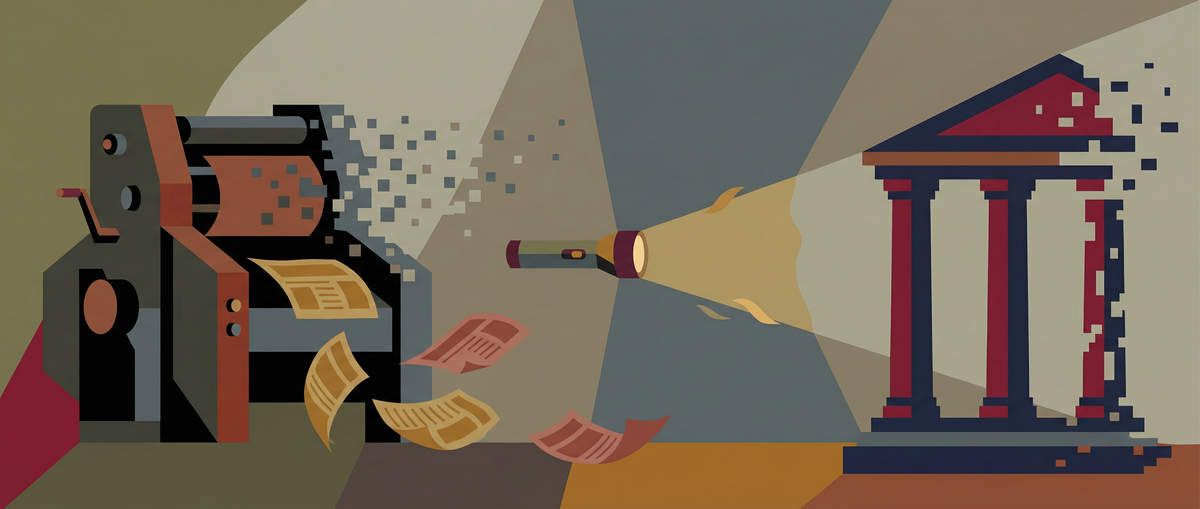
This article is not about the Washington Post’s management failures, though they were significant. It is about something much bigger and much older. It is about a pattern that has repeated itself at least five times in the past 600 years: the emergence of a new information technology, the destruction of the institutions that controlled the old one, and the resulting upheaval in political power.
History Future Now argues that the collapse of the institutional press is not a business story. It is a power story. Whoever controls the flow of information controls the distribution of power. When the technology that carries information changes, the institutions that depend on the old technology collapse, and the political order that those institutions sustained collapses with them. This has happened with the invention of the printing press, with cheap newspapers, with the telegraph, with radio and television, and it is happening now with the internet and artificial intelligence.
Each transition produced a period of extraordinary chaos — religious wars, revolutions, the rise of demagogues — before new institutions emerged to stabilise the system. We are in one of those chaotic periods right now. Understanding the previous ones helps explain what is coming next.
The First Revolution: The Printing Press and the End of the Catholic Monopoly (1450–1648)
Five Information Revolutions
Every revolution in information technology has destroyed the institutions that controlled the old one and produced decades of political chaos before new institutions stabilised the system.
Source: History Future Now analysis.
Before Gutenberg, information was controlled by the people who could afford to produce books by hand. In practice, that meant the Catholic Church. Monasteries were the libraries, schools, and publishing houses of medieval Europe. The Church decided what was written, what was copied, what was taught, and what was suppressed. This monopoly on information gave the Church extraordinary political power — the power to crown kings, to excommunicate emperors, and to mobilise entire nations for crusades.
The printing press, introduced in Europe around 1450, destroyed this monopoly in a single generation. Books that had cost a year’s wages for a skilled craftsman suddenly cost a few weeks’ wages. By 1500, an estimated 20 million volumes had been printed in Europe. By 1600, it was 200 million. Information that had been confined to monasteries and royal courts flooded out into the hands of merchants, lawyers, minor nobility, and eventually ordinary literate citizens.
The political consequences were immediate and catastrophic. Martin Luther’s 95 Theses, posted in 1517, would have remained a local academic dispute without the printing press. Instead, they were printed, translated, and distributed across Germany within weeks. Within months they had reached every corner of Europe. The Church, which had survived previous challenges to its authority by controlling the flow of information, found itself unable to suppress Luther’s arguments. People could read them for themselves. The Reformation was, in a very real sense, the first viral information event.
What followed was 130 years of religious warfare, political upheaval, and social chaos, culminating in the Thirty Years’ War, which killed between 20% and 40% of Germany’s population. The printing press had not caused these wars in the way that a bullet causes a wound. But it had destroyed the institution — the Catholic Church’s information monopoly — that had maintained a certain kind of political order. The new technology empowered new voices, and those voices had very different ideas about how the world should be organised.
It took over a century for new institutions to emerge that could manage the information environment created by the printing press. The Peace of Westphalia in 1648 established the modern state system, with its principles of sovereignty and non-interference. State-run censorship, licensing of printers, and eventually copyright law provided new frameworks for controlling the flow of information. The chaos subsided. But the Catholic Church never recovered its monopoly on information, and the political order it had sustained was gone for good.
The Second Revolution: Cheap Newspapers and Mass Democracy (1830–1900)
For the first 350 years after Gutenberg, the printing press remained expensive enough that publishing was the preserve of the wealthy, the educated, and the state. Books and pamphlets circulated among elites. Newspapers existed, but they were expensive, small-circulation affairs aimed at merchants, politicians, and the aristocracy.
This changed dramatically in the 1830s and 1840s with a series of technological innovations: the steam-powered rotary press, cheap wood-pulp paper, and eventually the Linotype machine. Together, these inventions reduced the cost of printing a newspaper by more than 90%. The “penny press” was born — cheap, mass-circulation daily newspapers aimed not at elites but at ordinary working people.
The political consequences were transformative. Mass-circulation newspapers created, for the first time, a genuinely informed public. Citizens who had previously relied on word of mouth, sermons, and local gossip for their understanding of the world could now read daily accounts of what their government was doing. This transparency was uncomfortable for those in power. The term “Fourth Estate” — the idea that the press served as an unofficial fourth branch of government, holding the other three to account — emerged in this period. Thomas Carlyle attributed it to Edmund Burke, who supposedly said that “there were Three Estates in Parliament; but, in the Reporters’ Gallery yonder, there sat a Fourth Estate more important far than they all.”
Cheap newspapers enabled mass democracy. Not because they were inherently democratic — many were owned by wealthy individuals with their own political agendas — but because they made it impossible for governments to operate in secret. A politician who took a bribe, a general who lost a battle through incompetence, a factory owner who poisoned his workers — all of these could now be exposed to millions of readers within hours.
But cheap newspapers also enabled something else: mass manipulation. William Randolph Hearst’s newspapers helped push the United States into the Spanish-American War in 1898. Lord Northcliffe’s Daily Mail and Daily Mirror shaped British public opinion for decades. Newspaper proprietors discovered that they could manufacture consent, create panics, and destroy political careers. As the American journalist A.J. Liebling observed, “freedom of the press belongs to those who own one.”
The relationship between press power and political power was always complicated. Newspapers held governments to account, but they also served the interests of their owners. Still, the system worked reasonably well for over a century. Newspapers employed armies of reporters who covered every level of government, from parish councils to parliaments. They maintained foreign correspondents in every major capital. They investigated corruption, exposed scandals, and provided citizens with the information they needed to make informed decisions. For all their flaws, newspapers were the infrastructure of democratic accountability.
The Third Revolution: The Telegraph, Radio, and the Rise of Mass Propaganda (1840–1950)
The telegraph, introduced commercially in the 1840s, and radio, which became widespread in the 1920s, did not destroy newspapers. But they fundamentally changed the speed and reach of information, and in doing so they shifted the balance of power toward those who controlled these new technologies.
The telegraph allowed information to travel faster than any human being. Before the telegraph, news from distant events took days, weeks, or months to arrive. After the telegraph, it arrived in minutes. This dramatically increased the power of centralised news agencies — Reuters, the Associated Press, Havas — which could gather information from around the world and distribute it to newspapers everywhere. The telegraph also gave governments a new tool for controlling information. Telegraph lines could be tapped, censored, or cut.
Radio was more revolutionary still. For the first time, a single voice could reach millions of people simultaneously, in their homes, without the intermediation of the printed word. This was a qualitative change, not just a quantitative one. The printed word requires literacy. It can be re-read, analysed, and argued with. Radio is immediate, emotional, and ephemeral. It appeals to feeling rather than reason.
The political implications were enormous. Franklin Roosevelt used radio masterfully with his “fireside chats,” speaking directly to the American people in a way that created an unprecedented bond between president and public. But the same technology also enabled the most effective propaganda machines in human history. Adolf Hitler understood radio’s power instinctively. Joseph Goebbels made it the centrepiece of Nazi propaganda, ensuring that every German household had a cheap radio — the Volksempfänger, or “people’s receiver” — that was designed to receive only German stations.
Radio did not create fascism. But it gave authoritarian leaders a tool for mass manipulation that was qualitatively different from anything available through print. A newspaper editorial could be rebutted by another newspaper editorial. A radio broadcast entered the mind directly, and there was no equivalent mechanism for rebuttal. The listener was passive, the speaker all-powerful.
Television extended radio’s logic further. The Nixon-Kennedy debate of 1960 is often cited as the moment when television transformed politics — those who listened on radio thought Nixon had won; those who watched on television thought Kennedy had won. The medium rewarded those who performed well on screen, regardless of the substance of what they were saying.
But here is the critical point: despite the arrival of telegraph, radio, and television, newspapers survived. More than survived — they thrived. Television could broadcast events. But it could not investigate them. Radio could move people’s emotions. But it could not hold the government to account through painstaking, multi-month investigations requiring teams of reporters, fact-checkers, and editors. Newspapers retained their role as the primary engine of democratic accountability even as they lost their monopoly on delivering news.
This is what many people fail to understand about the current crisis. When the Washington Post lays off half its newsroom, it is not the equivalent of a television network cancelling a show. It is the equivalent of shutting down the local police force. Nobody else is going to do the work that investigative reporters do. Television news relies heavily on newspaper reporting. Online news sites rely on newspaper reporting. Much of what people discuss on social media originated with a reporter at a newspaper who spent weeks or months uncovering the story.
The Fourth Revolution: The Internet and the Destruction of the Newspaper Business Model (1995–2026)
To understand why newspapers are dying, you need to understand how they made money. It was never really about selling news.
From the mid-1800s until the early 2000s, newspapers were sustained by a business model so reliable that it was often described as a “licence to print money.” That model was classified advertising. If you wanted to sell a house, hire an employee, buy a car, or announce a death, you placed an advertisement in your local newspaper. The newspaper had a near-monopoly on this service because there was no alternative. Where else would you put a classified ad?
Display advertising — the large, branded advertisements from department stores, car companies, and consumer goods firms — provided additional revenue. Together, classified and display advertising accounted for roughly 80% of newspaper revenue. Subscriptions and newsstand sales covered most of the rest. The journalism itself was essentially free — it was the bait that attracted readers, who attracted advertisers, who paid the bills.
The internet destroyed this model in two stages.
First, it destroyed classified advertising. Craigslist, launched in 1995, offered classified ads for free. eBay provided a marketplace for goods. Monster.com and later LinkedIn took over job listings. Rightmove and Zillow captured property listings. One by one, the revenue streams that had sustained newspapers for over a century were diverted to online platforms that did the same job faster, cheaper, and better. By 2020, US newspaper advertising revenue had fallen from $49 billion in 2006 to under $9 billion — a decline of over 80% in just 14 years.
Second, the internet destroyed the geographic monopoly that had given newspapers their pricing power. In the print era, a reader in London could choose between a handful of national newspapers and their local paper. That was the entire market. The internet offered unlimited competition from everywhere, for free. Why would you pay for the local paper’s foreign coverage when you could read the BBC, the Guardian, the New York Times, Al Jazeera, and a hundred other sources at no cost?
The results have been catastrophic. In the United States, newspaper employment has fallen from roughly 71,000 journalists in 2008 to around 30,000 today. Over 2,500 newspapers have closed since 2005, and more than half of all US counties now have either no local newspaper or only one — creating what researchers call “news deserts.” In the United Kingdom, roughly 300 local newspapers have closed since 2009. In both countries, the trend is accelerating.
The consequences for democratic accountability are severe and, in many places, already measurable. Research has consistently shown that when local newspapers close, voter participation declines, municipal borrowing costs increase, corruption increases, and fewer people run for local office. This makes intuitive sense. If nobody is watching, why would the powerful behave? The entire edifice of democratic accountability rests on the assumption that someone is paying attention — that misdeeds will be discovered, reported, and punished. Remove the reporter, and you remove the mechanism.
The Collapse of US Newspaper Employment
US newspaper employment has fallen 80% from 458,000 in 1990 to under 87,000 in 2025. Over 3,500 newspapers have closed since 2005. 50 million Americans now have limited or no access to local news.
Source: Bureau of Labor Statistics, Northwestern Medill Local News Initiative.
The Washington Post situation is particularly instructive because it shows that even a newspaper owned by one of the world’s richest men is not immune. Jeff Bezos, with a net worth of roughly $260 billion, bought the Post in 2013 for $250 million — loose change by his standards. The paper thrived initially, adding subscribers and digital capabilities. Then came a series of decisions that accelerated its decline: the abrupt cancellation of a presidential endorsement in late 2024 led hundreds of thousands of subscribers to cancel, and the installation of new management with a different editorial vision alienated more. But even without these self-inflicted wounds, the structural pressures — declining advertising, unlimited competition, audience fragmentation — were pushing the paper toward a reckoning.
The New York Times has, so far, bucked this trend. It has 12.8 million subscribers and is growing. But the Times is the exception that proves the rule. It has achieved this by transforming itself from a newspaper into a diversified digital media company — adding cooking, games, sports, and lifestyle content alongside its journalism. It is, in effect, a subscription bundle that happens to include excellent news coverage. Most newspapers do not have the brand recognition, the resources, or the audience to replicate this strategy.
The Fifth Revolution: Artificial Intelligence and the End of the Information Middleman (2023–?)
If the internet destroyed the newspaper business model, artificial intelligence threatens to destroy the product itself.
Newspapers — and journalism more broadly — have always been in the business of mediation. Reporters gather information. Editors select what is important. Fact-checkers verify claims. The finished product — a news article — is a curated, contextualised piece of information that tells the reader what happened, why it matters, and what might happen next. This mediation function is what distinguishes journalism from raw data.
AI threatens to short-circuit this process. Large language models can already synthesise vast quantities of information, answer questions, summarise events, and generate plausible-sounding analysis. They do this at essentially zero marginal cost, instantaneously, and in response to individual user queries. Why would a reader go to the Washington Post to understand a trade policy when they can ask an AI to explain it in plain language, tailored to their level of knowledge, in seconds?
There are obvious problems with this model. AI systems can generate plausible but inaccurate information. They have no ability to conduct original reporting — they cannot knock on doors, file freedom of information requests, cultivate sources, or sit through court proceedings. They depend entirely on information produced by others. If the journalists who produce that information lose their jobs, the AI has nothing to synthesise.
But this feedback loop may not save journalism. The market does not always behave rationally. If readers switch from paying for journalism to consuming AI-generated summaries of journalism, the economic model that supports original reporting collapses — even though the AI depends on the reporting for its raw material. This is a classic tragedy of the commons: everyone benefits from journalism existing, but nobody wants to pay for it individually, and AI has made it possible to consume the benefits without paying the cost.
The early signs are already visible. AI-generated news summaries are appearing in search results, reducing click-through traffic to newspaper websites. AI chatbots are answering questions that readers would previously have searched for on news sites. Some estimates suggest that AI-driven search changes could reduce news website traffic by 25% to 40% over the coming years. For newspapers that are already struggling with declining advertising and subscriptions, this could be the killing blow.
What Happens When Nobody Is Watching?
Every previous information revolution produced a period of chaos between the collapse of the old order and the establishment of a new one. The period between the printing press and the Peace of Westphalia was 200 years of religious wars. The period between cheap newspapers and the establishment of professional journalistic norms was marked by the “yellow journalism” era, in which newspapers routinely fabricated stories and manipulated public opinion to start wars.
We are in one of those transitional periods now. The old institutions of information — newspapers, the broadcast networks, the professional press — are collapsing. But no new institution has yet emerged to replace them.
What has filled the vacuum, so far, is a combination of social media platforms, partisan news operations, newsletters, podcasts, and AI. None of these, individually or collectively, performs the accountability function that newspapers performed. Social media is good at amplifying information but terrible at verifying it. Partisan news operations serve their audience’s existing beliefs rather than challenging them. Newsletters and podcasts can produce excellent analysis, but they lack the resources for sustained investigative reporting. AI, as discussed, depends on information produced by others.
The result is an information environment that is simultaneously more abundant and less reliable than at any point in human history. There is more information available to the average citizen than ever before. But the proportion of that information that has been verified, contextualised, and produced by someone with a professional obligation to accuracy has never been lower.
The Advertising Revenue Cliff
US newspaper ad revenue collapsed from $49B in 2006 to under $9B by 2023 — an 82% decline. Digital advertising never came close to replacing lost print revenue.
Source: Pew Research Center, Newspaper Association of America.
This has direct political consequences. When local newspapers close, corruption measurably increases. When national newspapers weaken, the ability of governments to operate without scrutiny expands. The politicians who benefit most from the collapse of the press are those who are least constrained by norms and most willing to lie — because the institution whose job it was to call out lies is no longer strong enough to do so effectively.
History teaches us that these transitional periods are dangerous. The chaos between the printing press and Westphalia produced the Thirty Years’ War. The chaos between radio and the development of media regulation enabled fascist and communist propaganda machines. The current transitional period is already producing a measurable decline in democratic accountability, an increase in political polarisation, and a growing inability of citizens to distinguish verified information from fabrication.
The Question That Should Worry You
Here is the question that should keep anyone who cares about self-governance awake at night, and it is a question that cuts across the usual political lines.
It is fashionable, particularly on the right, to celebrate the decline of legacy media. And there are legitimate reasons for dissatisfaction. Major newspapers have, over the past two decades, developed a marked progressive bias in their coverage that alienated a substantial portion of their readership. The New York Times’ news pages became, at times, difficult to distinguish from its editorial pages. The Washington Post’s motto, “Democracy Dies in Darkness,” came to feel ironic given its own editorial choices. Trust in media has declined for a reason, and that reason is not simply that the public became stupid.
But the alternative to biased institutional journalism is not unbiased journalism. The alternative, as we can already see, is no journalism — at least not the kind that involves reporters spending six months investigating a corrupt government contract, or three years exposing a corporate fraud, or a decade tracking how public money is actually spent.
The question is: who does this work when the newspapers are gone?
The answer, so far, is: nobody.
Conservative politicians who celebrate the decline of the mainstream media should consider who will investigate the next local government corruption scandal, the next fraudulent defence contractor, or the next abuse of eminent domain. Progressive politicians who demand more “responsible” coverage should consider that the alternative to imperfect coverage is no coverage at all.
This is not a left-right issue. Accountability journalism protects citizens of all political persuasions from the abuse of power by people of all political persuasions. A conservative farmer whose land is being seized by a government agency needs a reporter just as much as a progressive whistleblower inside a corporation. When the reporters are gone, the powerful — of whatever political stripe — are free to do as they please.
A Tale of Two Newspapers: NYT vs Washington Post
The New York Times transformed into a diversified digital subscription business with 12.8 million subscribers. The Washington Post lost nearly half its newsroom in a single day.
Source: NYT earnings, WaPo Guild, media reports.
The Precedent Nobody Wants To Think About
History offers a precedent for what happens when the institutions that hold power to account are destroyed without replacement. It is not a comfortable one.
In the late Roman Republic, the system of checks and balances that had sustained Roman governance for centuries was gradually hollowed out. The Senate still existed. The law courts still functioned. The forms of the Republic were maintained. But the substance — the genuine ability of these institutions to constrain the powerful — had been eroded over generations. By the time of Julius Caesar, the Republic was a shell. The institutions that were supposed to prevent any one individual from accumulating too much power were too weak to do their job. The Republic did not fall in a single dramatic moment. It decayed, slowly, as the mechanisms of accountability lost their teeth one by one.
The Roman Republic did not have newspapers, obviously. But it had functional equivalents: the tribunes who represented the interests of the common people, the Senate’s investigative powers, the public posting of laws and accounts, the tradition of public rhetoric in the Forum. When these mechanisms of transparency and accountability weakened, power concentrated. When power concentrated, the Republic ended.
The point is not that the fall of the Washington Post will lead to dictatorship. The point is that the institutions of accountability are fragile, that they can be destroyed faster than they can be built, and that once they are gone, the political consequences take decades to become fully apparent.
What Comes Next
Every previous information revolution eventually produced a new institutional framework that restored a degree of order and accountability. The printing press eventually led to copyright law, licensing, and state regulation. Cheap newspapers led to professional journalistic standards, press freedom protections, and anti-monopoly regulation. Radio and television led to broadcast licensing, public service broadcasting, and the Fairness Doctrine.
What will the internet and AI revolution produce?
There are some possibilities. Public service journalism, funded by taxation or endowments rather than advertising, could fill some of the gap — the BBC model, essentially. Philanthropic funding for investigative journalism is growing, with organisations like ProPublica, the Bureau of Investigative Journalism, and the Marshall Project producing high-quality work. Some countries are experimenting with direct public subsidies for local journalism.
Technology itself may provide partial solutions. AI could, in theory, reduce the cost of certain journalistic tasks — summarising court records, monitoring public spending, analysing corporate filings — freeing human reporters to focus on the parts of journalism that require human judgment, relationships, and persistence. Blockchain-based verification systems could help authenticate original reporting and track its provenance.
But History Future Now would argue that none of these solutions, alone or together, will be sufficient without a fundamental recognition of what journalism actually is: not a market product, but a public good. Clean air, safe streets, and honest government are all public goods — things that benefit everyone, that the market undersupplies, and that therefore require collective provision. Accountability journalism belongs in this category. It benefits everyone who lives under a government, regardless of whether they personally read a newspaper.
The question is whether democratic societies will recognise this before it is too late, or whether they will only understand what they have lost after the consequences have become irreversible.
Every previous information revolution produced decades of chaos before new institutions emerged. The printing press led to 130 years of religious war. The lesson is not that the chaos is inevitable. The lesson is that the chaos is the default — and that escaping it requires deliberate, sustained institutional innovation.
We have about ten years before the current generation of accountability journalists — the ones trained in the old system, with the institutional memory and the professional skills — retires or is laid off for good. After that, the knowledge of how to investigate, verify, and hold power to account will be genuinely lost. It took centuries to build those institutions. It will take a single generation to destroy them.
But here is the detail that should make you stop scrolling and think.
You are reading this article on a website that contains no advertising. It was not produced by a newspaper. It was not funded by a billionaire. It was not generated by an algorithm optimising for your engagement. It exists because someone decided that long-form analysis of historical patterns matters enough to create for free.
Now consider: where did the information in this article come from? The statistics on newspaper closures were gathered by researchers at Northwestern University — funded by an endowment. The employment data came from the Bureau of Labor Statistics — a government agency. The historical analysis draws on centuries of scholarship preserved in universities and libraries — institutions maintained by public investment. The news about the Washington Post layoffs was reported by journalists at NPR, CNN, the New York Times, and Al Jazeera — every one of them a news organisation that still employs reporters to sit in press conferences, make phone calls, and verify facts.
Pull on any thread of information in your daily life — any fact you rely on to make decisions about your health, your finances, your community, your vote — and at the other end of that thread, you will almost always find a journalist, a researcher, or a public servant who was paid to discover and verify that information. The entire information ecosystem that allows democratic societies to function depends on a surprisingly small number of people doing unglamorous, expensive, time-consuming work that the market increasingly refuses to fund.
Here is a number that should haunt you: there are now more public relations professionals in the United States than there are journalists. The people paid to shape the narrative outnumber the people paid to discover the truth by roughly six to one. In 1980, the ratio was roughly two to one. Every year, the gap widens. Every year, more of what you read, hear, and see was created not to inform you, but to persuade you — and the institutions that used to stand between the persuaders and the public are shrinking toward irrelevance.
February 4th 2026 — the day a war correspondent learned she had been fired while sheltering from Russian drones — was not the day journalism died. Journalism is dying the way Hemingway described going bankrupt: gradually, then suddenly.
The canary has stopped singing. The question now is what you do about the air in the mine.