In January 2025, the Edelman Trust Barometer delivered its annual verdict on public confidence across twenty-eight countries. The headline number — fifty-one per cent average trust in government — masked a collapse in most Western democracies. In the United States, trust in the federal government to “do the right thing” stood at sixteen per cent, down from a peak of seventy-seven per cent in 1964, the highest reading Pew Research Center has recorded since it began tracking the question in 1958. In the United Kingdom, twelve per cent of the public trusted Parliament to act in the national interest. In France, trust in political parties had fallen to nine per cent. The French, it appears, have rather more confidence in the weather forecast than in the people who govern them.
The Roman Senate lasted nine hundred years. The House of Lords has lasted eight hundred. The United States Congress has lasted 235 and already looks like it needs life support. At this rate, the European Parliament will be fortunate to see its centenary.
This is not a mood. It is not a polling blip that will correct with a better class of politician. It is a structural collapse in the legitimacy of the institutions that underpin Western civilisation — government, the press, the judiciary, the scientific establishment, organised religion, and the post-1945 international order. Gallup’s long-running confidence surveys show that trust in virtually every major American institution has declined since the early 1970s, most of them precipitously. The pattern in Europe is the same. The standard explanation — that scandals, social media, and “populism” have eroded public confidence — is comfortable for those who run the institutions because it locates the problem in the public rather than in themselves. It is also wrong. The structural cause is simpler and more damning: Western governments have grown so large, so self-serving, and so detached from the people who elect them that voters have concluded — rationally and correctly — that the system no longer works for them.
Trust in Government Over Time: US, UK, France, Germany (1960–2025)
A sixty-year collapse in the most fundamental measure of democratic legitimacy
Source: Pew Research Center; Eurobarometer; Edelman Trust Barometer
What Trust Is — and What Happens When It Goes
Trust, in the context of institutions, is not a feeling. It is a calculation — a rational expectation that an institution will behave predictably, competently, and in the interests of those it serves. Francis Fukuyama, in Trust, argued that it is the foundation of social capital: the invisible infrastructure upon which everything else is built. High-trust societies — Denmark, Norway, Finland — have lower transaction costs, less corruption, and more effective public services. Low-trust societies — Russia, Brazil, Nigeria — must compensate with coercion, surveillance, and elaborate enforcement mechanisms that absorb productive capacity and breed resentment.
The dynamic is straightforward: when people trust institutions, they cooperate voluntarily. When they do not, cooperation must be compelled — and compulsion is expensive, corrosive, and ultimately unsustainable. Tax compliance falls. Jury service is evaded. Public health guidance is ignored. The institution then performs worse, spending resources on enforcement rather than service, which confirms the public’s distrust and accelerates the decline. It is a doom loop, and it has a ratchet: trust lost is far harder to rebuild than trust maintained.
Trust Across Institutions: The Universal Decline (Latest Data)
No institution has been spared — government, media, business, science, and religion all face a credibility crisis
Source: Edelman Trust Barometer 2025; Gallup
Robert Putnam documented this in Bowling Alone: the decline in American civic participation — unions, churches, clubs, volunteer organisations — began in the 1960s and accelerated through the 1980s and 1990s. The institutions that had once embedded trust in daily life — the PTA, the Rotary Club, the local church — withered. What replaced them was television, then the internet, then social media: technologies that connected people to information but disconnected them from one another. The social fabric frayed before the political fabric did.
When Rome Stopped Trusting the Senate
For roughly four centuries, the Roman Senate was the most respected governing body in the ancient world. Roman citizens — even those who grumbled — broadly accepted that the Senate governed in the public interest. The crisis that destroyed this legitimacy began not with an invasion or a natural disaster, but with corruption so visible and so shameless that it could no longer be denied.
By the late second century BC, the Senate had been captured by a narrow oligarchy of wealthy families. Roman public land — the ager publicus, owned by the state and theoretically available for citizen settlement — had been overwhelmingly occupied by senatorial families in flagrant violation of existing law. The brothers Tiberius and Gaius Gracchus attempted to enforce the land limits and redistribute surplus to landless citizens — a moderate reform, entirely within existing legal frameworks. The Senate’s response was murder. Tiberius was beaten to death by a mob of senators and their supporters in 133 BC — the first political killing in the Republic in nearly four centuries. Gaius was driven to suicide twelve years later. The message was unmistakable: the Senate would kill its own members rather than permit reform that threatened senatorial wealth.
The courts were corrupt — provincial governors looted with near-impunity, and the juries that theoretically held them accountable were their fellow senators. Elections were openly purchased. The result was a progressive transfer of loyalty from the Republic’s collective institutions to individuals who promised to fix them — Marius, Sulla, Pompey, Caesar. The public had lost faith in the institutions and was willing to vest extraordinary power in outsiders who promised to break the system open.
Julius Caesar crossed the Rubicon in 49 BC not as a revolutionary but as a man whose popular support exceeded the Senate’s institutional legitimacy. Within fifteen years of his assassination, Augustus had established a monarchy in all but name — and the public, exhausted by decades of institutional failure and civil war, accepted it with something approaching relief. The pattern is worth memorising, because it is the pattern we are living through: when institutions are captured by insiders who serve their own interests, the public transfers loyalty to outsiders who promise disruption.
When Europe Stopped Trusting the Church
The medieval Catholic Church was the closest thing Europe had to a continental government. It ran courts, collected taxes, conducted diplomacy, operated schools and universities, and provided the ideological framework that legitimised every monarch. Its authority rested on a claim to spiritual truth — and on a monopoly over the information infrastructure through which that truth was communicated.
The erosion of faith followed the same trajectory as Rome’s: institutional capture, visible corruption, and the destruction of the credibility that legitimacy requires. Simony — the sale of ecclesiastical offices — was endemic. The Avignon Papacy shattered the papacy’s claim to spiritual independence. The Great Western Schism gave Europe two and then three rival popes, each excommunicating the others — a situation that would have tested the credulity of the most devout. By the time Martin Luther nailed his Ninety-Five Theses to the door at Wittenberg in 1517, the kindling had been piling up for two hundred years. The printing press — barely seventy years old — was the accelerant. Luther’s pamphlets reached a mass audience faster than the Church could suppress them, just as social media now disseminates criticism faster than institutions can respond.
The Reformation produced religious pluralism, the nation-state, and parliamentary governance. It also produced the Wars of Religion, which killed an estimated eight million people. The Thirty Years’ War alone killed perhaps a third of the German population. The transition from one institutional order to another is rarely gentle. The interval between “the old order has lost legitimacy” and “a new order has established itself” is the most dangerous period in the life of any civilisation.
The Leviathan: How Government Grew Beyond Democratic Control
This is where the modern collapse departs from the comforting narrative of “scandals eroding trust.” Scandals are triggers. The structural cause is that Western governments have grown into self-perpetuating bureaucratic states so large and so insulated from democratic accountability that they now function as interests in their own right — interests frequently opposed to those of the voters who fund them.
The Growth of the State: Government Spending as % of GDP (1900–2024)
In a single century the state grew from a night-watchman into a colossus consuming nearly half of everything citizens produce
Source: Tanzi & Schuknecht (2000); OECD; IMF Fiscal Monitor
The numbers tell the story. In 1900, total government spending across the Western world averaged roughly ten per cent of GDP. By 2024, it exceeded forty per cent in every major Western economy: forty-four per cent in the United Kingdom, forty-seven per cent in Germany, fifty-seven per cent in France. The United States, supposedly the land of small government, stands at thirty-six per cent. In a single century, the state grew from a night-watchman into a colossus that consumes nearly half of everything its citizens produce — and it shows no sign of having had enough.
The regulatory apparatus has kept pace. The United States Federal Register ran to roughly 14,500 pages in 1960. By 2024, it exceeded 100,000. The Code of Federal Regulations, which compiles all active rules, spans over 180,000 pages. No human being — no elected official, no voter, no business owner — can read or understand the regulatory framework that governs them. This is not governance. It is administrative entropy — a system that has grown beyond the comprehension of the people who nominally control it, let alone the citizens it is supposed to serve.
How Far They Have Fallen: US Institutional Confidence, Peak vs. 2025
Every major American institution has lost the majority of the public confidence it once commanded
Source: Gallup Confidence in Institutions (1973–2025)
And the bureaucracy that administers this apparatus does not answer to the electorate. In theory, a few hundred elected politicians sit atop the permanent state and direct it. In practice, the permanent state directs itself. Ministers come and go — the average tenure of a British Cabinet minister is two years. The senior civil servants who brief them, draft their legislation, and implement their decisions have been in post for decades. When a new government arrives with a mandate for change, the bureaucracy resists, delays, reinterprets, and waits it out. This is not a conspiracy theory. It is the observable, documented behaviour of every large bureaucracy in every Western democracy, described by political scientists from Max Weber to James Q. Wilson.
Supranational institutions compound the problem. The European Union’s officials are not elected by the citizens they govern. The European Commission proposes legislation that no voter chose and no referendum endorsed. Citizens cannot vote out the European Commission, cannot reject EU directives at the ballot box, and have no meaningful say in the appointment of the officials who regulate their lives. The trust decline in Brussels is not a bug. It is the predictable consequence of structures designed to be insulated from democratic accountability — which is a polite way of saying they were designed to be unaccountable.
The bureaucracy is further extended through organisations that style themselves “non-governmental” but are nothing of the sort. In the European Union, roughly sixty per cent of major NGO funding comes from government grants. Oxfam received over forty per cent of its income from governments in 2023. The International Rescue Committee received sixty-seven per cent. These are not independent voices of civil society. They are extensions of the state, funded by taxpayers, accountable to neither voters nor elected representatives, pursuing policy agendas the public never chose. When they lobby governments for more regulation, more spending, and more intervention, they are the state lobbying itself with public money, under a different letterhead. NGOs enjoy far higher public trust than the governments that fund them — which is precisely the point. The arrangement allows the administrative state to pursue unpopular policies through nominally independent proxies, manufacturing the appearance of civil society demand for agendas that voters never endorsed.
The result is a system that is structurally incapable of responding to democratic mandates. The voters want X. They elect a government that promises X. The government arrives in office and discovers that the bureaucracy, the quangos, the NGOs, the international treaty obligations, the judicial interpretations, and the sheer inertia of a forty-per-cent-of-GDP state make X impossible — or rather, make it impossible without a fight that most politicians lack the appetite for. And so the voters’ wishes are quietly shelved, and the voters, who are not stupid, notice.
The Democratic Betrayal
The most corrosive force in Western politics is not corruption in the classical sense — not senators stuffing their togas with gold. It is the systematic, repeated failure of democratic governments to do what voters elected them to do.
Brexit is the definitive modern example. In June 2016, 17.4 million people — the largest democratic exercise in British history — voted to leave the European Union. What followed was not implementation but three years of institutional resistance. Parliament voted repeatedly against the terms of departure. The Speaker of the House of Commons broke with centuries of precedent to allow procedural manoeuvres designed to block or dilute the result. Senior civil servants briefed against their own government’s policy. Legal challenges were mounted to prevent the executive from exercising powers the electorate had explicitly authorised. The message to British voters was unmistakable: your vote is advisory; the institutions will decide. It took the election of Boris Johnson with an eighty-seat majority — the largest Conservative mandate since Thatcher — to force the permanent state to comply with a referendum result that was, by then, three and a half years old.
The same pattern plays out on immigration across Europe. For two decades, voters in virtually every Western democracy have ranked immigration among their top concerns and consistently told pollsters they want less of it. Governments have consistently delivered more. Germany admitted over a million asylum seekers in 2015 despite polling showing sixty per cent of the public opposed it. Sweden maintained an open-door immigration policy for decades against overwhelming public opinion, reversing course only when the electoral rise of the Sweden Democrats — a party treated as pariah by the establishment precisely because it was listening to voters — made the status quo politically unsurvivable. In Britain, net migration reached 745,000 in 2023 under a Conservative government elected on an explicit promise to reduce it. The voters noticed.
In the United States, the phenomenon was laid bare during Donald Trump’s first term. Trump was elected in 2016 on a platform of immigration enforcement, trade protection, and scepticism of the foreign policy establishment. The federal bureaucracy’s response was not compliance but resistance. Career officials at the State Department, the intelligence agencies, and the Department of Justice openly worked to obstruct, slow-walk, or reverse presidential directives. Anonymous senior officials wrote op-eds in the New York Times boasting of their efforts to undermine the elected president from within. The term “the Resistance” was adopted not by the opposition party but by the permanent bureaucracy itself — and it was celebrated, not condemned, by the institutional media. The deep state, it turned out, was not a conspiracy theory. It was a job description.
This is the heart of the trust collapse. It is not that voters are irrational, misinformed, or susceptible to demagogues. It is that they have watched, repeatedly, as their democratic choices are ignored, diluted, or reversed by a permanent governing class that considers itself better informed and more morally serious than the electorate it was hired to serve. The voters have drawn the rational conclusion: the system does not work for them. And they are right.
What Fills the Vacuum
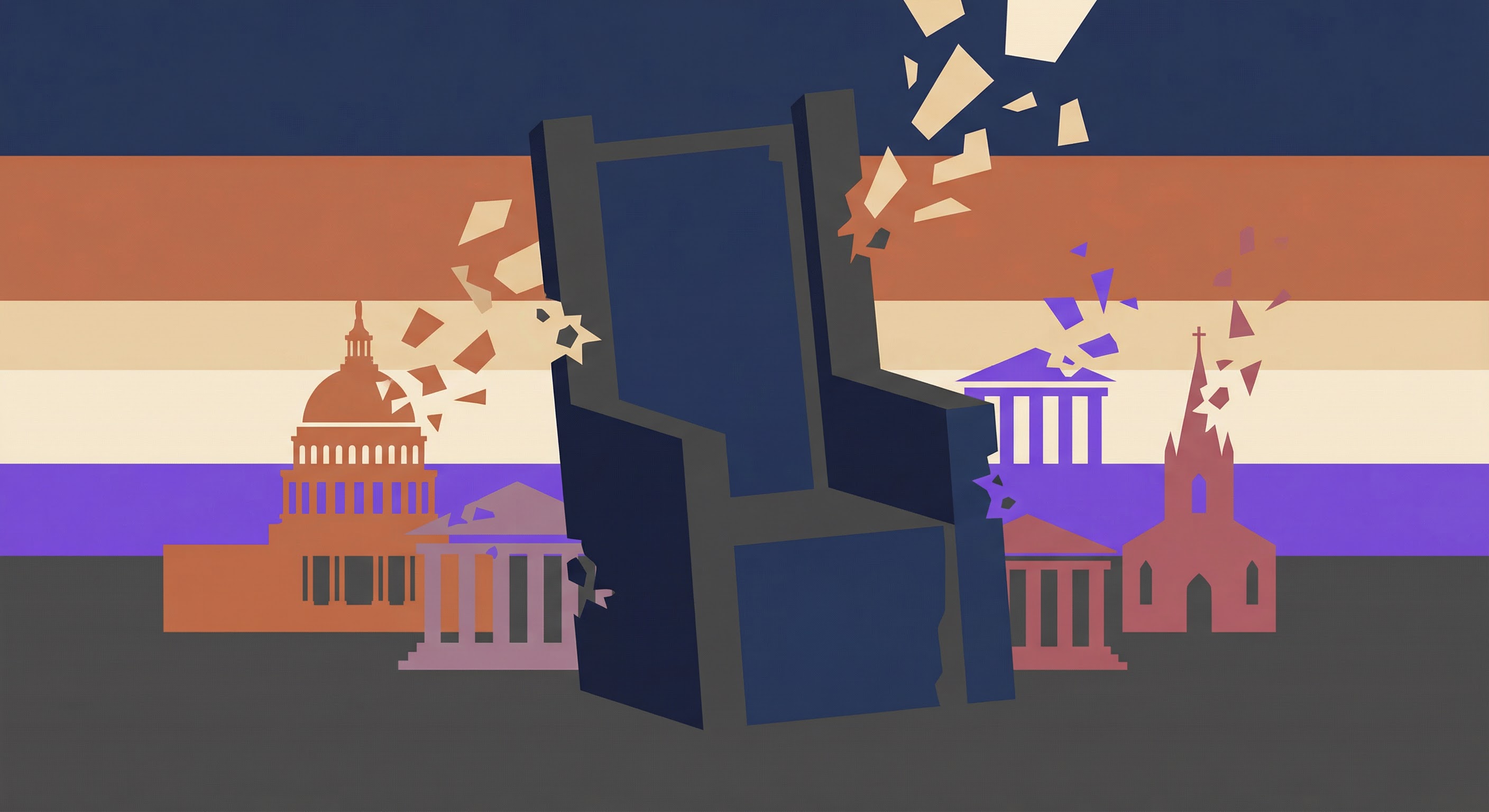
The empty throne never stays empty. In Rome, the vacuum was filled by strongmen — Marius, Sulla, Caesar, Augustus. In Reformation Europe, by new institutions — national churches, nation-states, parliamentary democracy, the free press. In the modern West, three forces are rushing in.
Populist Party Vote Share in Europe (2000–2024)
Populism is not an aberration — it is the predictable response to institutional failure
Source: ParlGov database; national election data
The first is democratic renewal through leaders who actually listen to voters. Trump, Orbán, Meloni, Milei — whatever their differences in policy, they share a single appeal: they promise to govern for the people who elected them rather than for the bureaucracy that preceded them. The establishment calls this populism and treats it as a pathology. It is the opposite. It is democracy reasserting itself against an administrative class that had quietly abandoned the principle that government should do what voters want. The policies these leaders promote — controlled immigration, national sovereignty, fiscal restraint, scepticism of supranational governance — were consensus centrist positions thirty years ago. The voters did not move. The bureaucratic and media class moved away from them and then labelled the voters’ unchanged positions as extreme.
The second is alternative epistemologies. When people stop trusting institutions to tell them the truth, they seek truth elsewhere. Conspiracy theories, alternative medicine, partisan media, and algorithmic echo chambers are not causes of the trust collapse; they are symptoms of it. To characterise these responses as “disinformation” or “post-truth” locates the problem in the public rather than in the institutions that forfeited the public’s confidence. The Romans who supported Caesar were not deluded. The Germans who read Luther were not victims of misinformation. They were people responding rationally to institutional failure.
The third is algorithmic trust. Among under-twenty-fives, thirty per cent now use TikTok as a primary news source; fifteen per cent read a daily newspaper. Trust is migrating from institutional brands — the BBC, the New York Times, Reuters — to individual creators and algorithmic curation. Whether this represents a democratisation of truth or its fragmentation is the defining information question of the decade.
What Comes Next
The current crisis is not a passing mood. It is a structural transformation of the kind that occurs perhaps once or twice per millennium — comparable in scope, if not yet in violence, to the fall of the Roman Republic and the Protestant Reformation. The decline began in the late 1960s and has now lasted over fifty years with no sign of reversing.
No amount of “rebuilding trust” through better communications will fix it. A government that consumes nearly half of GDP, employs millions of officials who answer to no electorate, funds a network of nominally independent organisations to lobby for its own expansion, and then systematically ignores democratic mandates when they conflict with bureaucratic preferences — that government does not have a communications problem. It has a legitimacy problem. And legitimacy, once lost, is not recovered by press releases.
But there is a more radical possibility than simply reforming the existing institutions or electing better leaders. The same artificial intelligence that is transforming the economy could eliminate the need for the bloated bureaucratic state altogether — and, in doing so, return governance to citizens themselves.
Consider Athens. In the fifth century BC, Athenian citizens — freed from survival labour by slave labour — did not lounge. Citizenship was among the most demanding social contracts ever devised. Citizens served on juries — the city empanelled 6,000 jurors each year, drawn by lot. They attended the Assembly on the Pnyx, debating and voting on war, peace, taxation, and law. They held public office, trained for military service, and engaged in the relentless, exhausting business of governing themselves. The Athenian who stayed home and tended only his own affairs was called an idiotes — the origin of our word “idiot” — meaning a private person who shirked public duty. In a city smaller than modern Nottingham, a single generation produced Socrates, Plato, Aristotle, Sophocles, and the Parthenon.
The Athenian model worked because the city-state was small enough for direct participation. Every citizen could walk to the Assembly. Every juror could hear the arguments. The bureaucratic state arose precisely because modern nations are too large and too complex for this: you need armies of administrators to coordinate what Athenians coordinated by showing up. But AI changes that calculation entirely. The coordination complexity that previously required bureaucracies — collecting information, processing claims, matching resources to needs, administering rules — is exactly what artificial intelligence handles best. Estonia has already demonstrated the principle: ninety-nine per cent of government services available online, most traditional bureaucracy eliminated, the system transparent by design. Switzerland’s binding referenda give citizens direct control over policy that in other democracies is left to legislators and lobbyists.
Now extend the logic. If AI can handle the administrative machinery of the state — the processing, the coordination, the information management that currently employs millions — then the vast bureaucratic apparatus that stands between citizens and their own governance becomes not merely bloated but unnecessary. Strip it away and what remains is something remarkably close to the Athenian model: citizens governing themselves directly, at the local and community level, with technology handling the complexity that once required a permanent administrative class.
This is not nostalgia. It is a forward-looking proposition enabled by technology that did not exist a decade ago. And it offers something that neither the bureaucratic state nor the populist strongman can provide: purpose. In a world where AI handles an ever-larger share of economic production, the question of what humans are for becomes urgent. The Athenians had an answer: self-governance. The business of being a citizen — deliberating, deciding, taking responsibility for the community you live in — is inherently, irreducibly human work. It cannot be delegated to an algorithm. It cannot be outsourced to a bureaucracy. It is the one domain where human judgment is not merely useful but essential, and where the exercise of that judgment makes the person exercising it more capable, not less.
The Roman Senate was hollowed out. The medieval Church was broken into pieces. In both cases, the old order’s defenders insisted until the very end that the problem was public ignorance — that the plebeians needed educating, that the laity needed guidance. They were wrong then. The throne is empty because the people who sat on it stopped serving the people who built it. But perhaps the answer is not to find someone better to sit on it. Perhaps the answer is to tear the throne down and let the citizens govern themselves — as they did, rather well, in Athens, before anyone thought to build a bureaucracy in their name.