In 2015, Angela Merkel stood before the cameras and said three words that will define her legacy more than any other act of her chancellorship: Wir schaffen das — we can manage this. Germany would open its borders to over a million asylum seekers, most from Syria, Afghanistan, and Iraq. It was presented as a moral imperative. The alternative, she implied, was unconscionable.
What Merkel did not say — what almost no Western leader has said in the past forty years — is that her decision was historically extraordinary. Not because it was generous. But because it was unprecedented. For five thousand years of recorded civilisation, every successful state tightly controlled who could enter, who could settle, and who could become a citizen. The idea that a nation should accept large numbers of culturally distinct foreigners as a matter of principle, rather than strategic necessity, has no precedent in human history before approximately 1965.
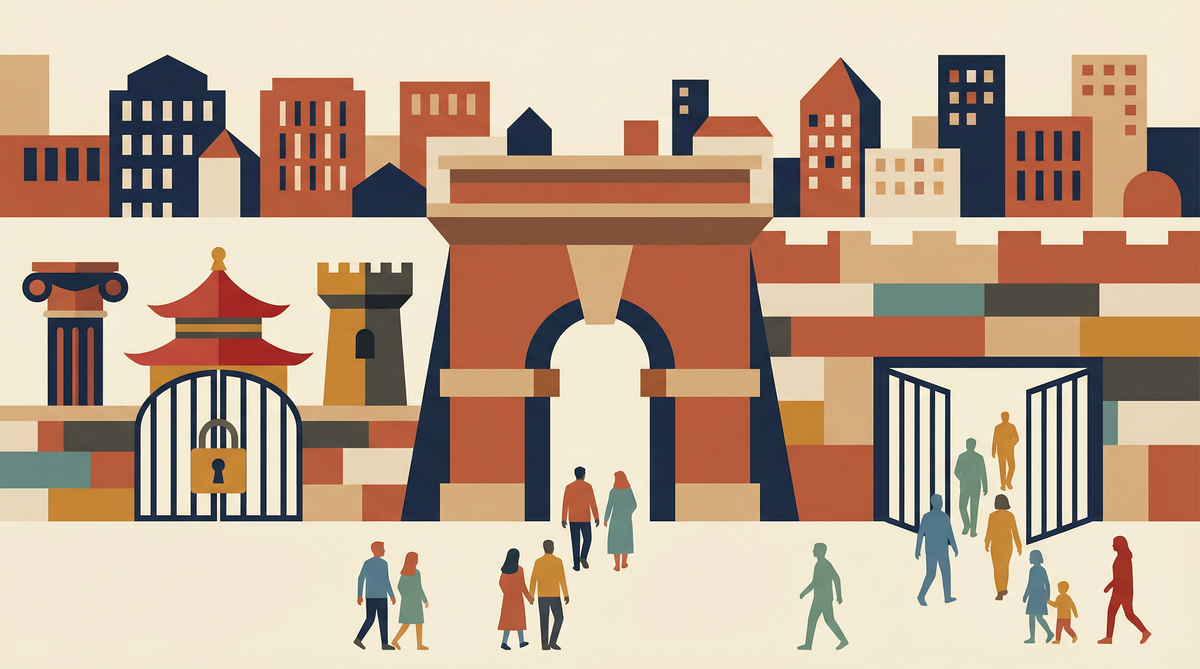
The Ottoman Empire managed dozens of ethnic groups for six centuries and never once suggested they were interchangeable. The Romans granted citizenship with exquisite care — until they didn’t, and the consequences were fatal. The Chinese built a wall. The Japanese closed their entire country for two hundred years. The Athenians, who invented democracy, restricted citizenship so tightly that Aristotle himself — who had lived in Athens for decades — could never vote.
And yet, if you suggest today that immigration policy should be selective, restrictive, or tied to cultural compatibility, you will be called a bigot. This is rather like being called a flat-earther for noting that gravity exists.
This article examines how civilisations across five millennia approached the movement of peoples, what happened when they got it wrong, and what the data tells us about where the West’s current experiment is heading.
The Ancient Default: Walls, Laws, and Suspicion
The historical norm is not merely border control. It is active hostility to uncontrolled migration. This was not irrational prejudice. It was survival.
Sumer and Egypt: The First Border States
The earliest civilisations for which we have records — Sumer, Egypt, Akkad — all maintained strict distinctions between citizens and foreigners. The Sumerian city-states (c. 3500–2000 BC) had specific legal categories for non-citizens, who were barred from owning land, holding office, or participating in religious rites. Egypt’s Middle Kingdom (c. 2055–1650 BC) maintained a network of fortresses along the Nubian border specifically to control the movement of peoples. The Semna Dispatches, administrative documents from these border posts, record the meticulous tracking of every foreigner who crossed — their name, origin, purpose, and expected departure date.
This was not xenophobia in the modern sense. It was statecraft. These civilisations understood something that modern policymakers have chosen to forget: that the character of a state is determined by the character of its people, and that changing the people changes the state.
Athens: Democracy for Athenians Only
Athens, the civilisation most often invoked as the ancestor of Western liberal values, had immigration policies that would make a modern populist blush. Under Pericles’ citizenship law of 451 BC, only those born to two Athenian parents could be citizens. Foreigners who lived and worked in Athens — the metics — paid a special tax, could not own land, could not vote, could not hold office, and could not marry Athenian citizens without special dispensation. Aristotle, who lived in Athens for most of his adult life, was a metic. So was Hippocrates.
The Athenians did not consider this unjust. They considered it obvious. Citizenship was not a right conferred by geography. It was an inheritance conferred by blood and culture. The polis was not a service provider. It was a community of shared identity, shared gods, and shared obligations.
China: The Wall as National Philosophy
China’s approach to immigration is perhaps the most instructive, because it was the most sustained and the most successful. From the Qin Dynasty’s first unification of the northern walls (c. 221 BC) through the Ming Dynasty’s massive reconstruction (1368–1644), the Great Wall was not merely a military fortification. It was a philosophical statement: civilisation ends here. Beyond this line are barbarians.
The Chinese did not build the Wall because they were ignorant of the peoples beyond it. They built it because they knew them intimately. The steppe nomads — Xiongnu, Turkic, Mongol — were militarily formidable, culturally alien, and, when admitted in large numbers, politically destabilising. The periods when the Wall was neglected or the borders were porous — the late Han, the late Tang, the late Song — were precisely the periods when China was conquered or fragmented by peoples from beyond it.
The lesson was not lost on subsequent dynasties. The Ming, having expelled the Mongol Yuan Dynasty, rebuilt the Wall with a thoroughness that bordered on obsession. They were not building against a specific threat. They were building against the principle of uncontrolled entry.
Japan: The Closed Country
Japan’s sakoku policy (1633–1853) represents the most extreme version of immigration control in recorded history. For over two hundred years, no foreigner could enter Japan and no Japanese could leave, on pain of death. Foreign trade was restricted to a single artificial island in Nagasaki harbour, where a handful of Dutch merchants were permitted to operate under suffocating restrictions.
The result was not stagnation. It was one of the most remarkable periods of cultural flowering in Japanese history. The Edo period produced kabuki, ukiyo-e, haiku, the tea ceremony in its mature form, and a level of urban sophistication that astonished the first Western visitors when the country was forcibly opened in the 1850s. Japan’s population was literate, healthy, and culturally cohesive to a degree unmatched anywhere in the contemporary world.
The sakoku policy was extreme. But it demonstrated something important: a society that controls its borders controls its destiny. Japan emerged from two centuries of isolation as the most culturally unified nation on earth, and within fifty years of opening had industrialised faster than any country in history.
Rome: The Cautionary Tale
No civilisation’s experience with immigration is more relevant to the modern West than Rome’s, because no civilisation’s trajectory more closely mirrors our own.
The Early Republic: Citizenship as Fortress
Early Rome was ferociously exclusive. Citizenship was restricted to freeborn Romans. The ius civitatis — the right of citizenship — was the most jealously guarded privilege in the ancient world. It conferred legal protections, voting rights, access to public land, and exemption from certain taxes and punishments. It could not be bought. It could only be inherited or, in rare cases, granted by the Senate for extraordinary service.
Rome’s Italian allies fought a war — the Social War of 91–88 BC — specifically to obtain Roman citizenship. The fact that they had to fight a war to get it tells you everything about how Rome valued it.
The Turning Point: Universal Citizenship
In AD 212, the Emperor Caracalla issued the Constitutio Antoniniana, granting Roman citizenship to virtually all free inhabitants of the empire. The stated reason was administrative convenience and tax revenue. The actual effect was to render citizenship meaningless. If everyone is a citizen, no one is.
Within two generations, the Roman army was predominantly staffed by Germanic foederati — barbarian soldiers serving under their own commanders, loyal to their own chiefs, fighting for Roman pay but not for Roman identity. By the fifth century, the distinction between Roman and barbarian had become so blurred that the “fall” of Rome in 476 was less a conquest than a change of management. Odoacer, the Germanic chieftain who deposed the last Western emperor, had been a Roman general.
The parallel with modern Western citizenship — increasingly detached from cultural identity, increasingly a matter of paperwork rather than belonging — is uncomfortable and precise.
The Modern Anomaly: How the West Opened Its Gates
Foreign-Born Population Share: US, UK, Germany, France (1900–2030)
After decades of restriction, Western nations opened their borders from the 1960s onward — a historically unprecedented shift
Source: UN Population Division; Migration Policy Institute; national census data. 2025–2030 projected.
The Open Gate: Foreign-Born Population as Share of Total (2024)
The West's experiment with mass immigration is historically unique — most nations in history tightly controlled who entered
Source: UN DESA International Migrant Stock 2024; OECD
The current Western approach to immigration is not the product of centuries of liberal evolution. It is the product of a single generation’s policy decisions, made between approximately 1948 and 1975, and it reversed millennia of practice.
The United States: From Restriction to Revolution
The United States, often presented as a “nation of immigrants,” was for most of its history a nation of selected immigrants. The Naturalization Act of 1790 restricted citizenship to “free white persons of good character.” The Chinese Exclusion Act of 1882 banned Chinese immigration entirely. The Immigration Act of 1924 established national-origin quotas designed to preserve the existing ethnic composition of the country — overwhelmingly Northern European.
This changed with the Hart-Celler Act of 1965, which abolished national-origin quotas and replaced them with a system based on family reunification and skills. The Act’s sponsors explicitly promised it would not change the ethnic composition of the country. Senator Ted Kennedy declared: “The bill will not flood our cities with immigrants. It will not upset the ethnic mix of our society.” He was wrong on both counts. The foreign-born share of the US population has risen from 4.7% in 1970 to over 14% today — the highest level in over a century.
Europe: The Post-War Labour Bargain
Europe’s transformation was different in mechanism but identical in outcome. Post-war labour shortages led to Gastarbeiter programmes in Germany, Commonwealth immigration in Britain, and North African recruitment in France. These were explicitly temporary arrangements. The workers were supposed to come, work, and go home.
They did not go home.
Germany’s Turkish Gastarbeiter population, recruited from the 1960s, has grown to over three million. Britain’s Commonwealth immigration, initially from the Caribbean and later from South Asia, has transformed the demographics of every major English city. France’s North African population, concentrated in the banlieues, has created what the French themselves call “territories lost to the Republic”.
In every case, the pattern is the same: temporary labour migration became permanent settlement, which became family reunification, which became community formation, which became a demographic and political fact that no government could reverse without measures no democracy would tolerate.
Public Opinion: The Gap That Never Closes
Public Opinion: "Immigration Should Be Reduced" (1965–2024)
In every Western country, majorities have consistently wanted less immigration — and been consistently ignored
Source: Gallup (US); Ipsos MORI (UK); Infratest dimap (Germany). Selected survey years.
Perhaps the most striking feature of Western immigration policy is the persistent gap between what governments do and what citizens want. This is not a recent phenomenon. It has been a constant for over fifty years.
In Britain, every major survey since the 1960s has shown that a majority of the public wants immigration reduced. Ipsos MORI’s long-running tracker shows that immigration has been named as one of the top issues facing the country in every survey since 2001, and “too much immigration” has been the majority view for as long as the question has been asked. The 2016 Brexit vote was, at its core, a vote about immigration — and it was won by the side that promised to reduce it.
In the United States, Gallup polling shows that the percentage of Americans who want immigration decreased has exceeded those who want it increased in every year since 1965 — the very year the Hart-Celler Act was passed. As of 2024, 55% of Americans want immigration reduced, versus 16% who want it increased.
In Germany, the Willkommenskultur of 2015 evaporated within months. By 2016, Merkel’s approval ratings had collapsed, and the anti-immigration Alternative for Germany (AfD) had become the country’s third-largest party. By 2024, it was polling as the second-largest.
The pattern is universal across the Western world: governments pursue high immigration; publics oppose it; governments ignore the opposition; new parties emerge that actually listen to voters; the establishment labels them “populist” as though democratic responsiveness were a disease; mainstream parties belatedly adopt restrictionist rhetoric while changing little in practice.
What the Data Shows: Integration, Fiscal Impact, and Social Trust
The debate about immigration is often conducted in moral terms — compassion versus cruelty, openness versus bigotry. But the data tells a more complicated story.
The Integration Problem
The assumption underlying Western immigration policy is that immigrants will integrate — adopt the language, values, and civic habits of the host society within a generation or two. For some groups, this has been broadly true. East Asian immigrants to the United States, for example, outperform the native-born population on virtually every measure within a single generation.
For other groups, the picture is starkly different. In France, third-generation North African immigrants still have unemployment rates roughly double the national average. In Sweden, immigrants from Somalia, Afghanistan, and Iraq have employment rates below 40% after ten years of residence. In Germany, Turkish-origin residents in the third generation still show significant gaps in educational attainment and labour-force participation.
These are not failures of individual effort. They are structural patterns that persist across generations, and they suggest that the assumption of automatic integration is, for certain origin-destination combinations, simply wrong.
The Fiscal Equation
Net Fiscal Impact of Immigration by Origin Group
The fiscal impact of immigration depends heavily on origin — a fact most governments prefer not to disaggregate
Source: Danish Ministry of Finance (2018); Dutch CPB (2003); UK MAC (2018). Annual net fiscal contribution per capita, approximate.
The fiscal impact of immigration is the question that most Western governments would prefer not to answer honestly. The evidence, when disaggregated by origin, is uncomfortable.
The most comprehensive study to date was published in 2023 by a team at the University of Amsterdam. Borderless Welfare State, by Jan van de Beek and colleagues, used anonymised microdata from Statistics Netherlands covering all 17 million residents to calculate the lifetime net fiscal contribution of every immigrant — taxes paid minus benefits received, from arrival through death. The results varied by a factor of forty. Immigrants from North America, Japan, the United Kingdom, and Scandinavia contributed between €194,000 and €208,000 per person over their lifetimes. Immigrants from the Horn of Africa and Sudan cost €606,000 per person. From Morocco: €542,000. From Afghanistan, Syria, and Iraq: €418,000. Asylum seekers averaged €475,000. The total cost of immigration to the Dutch treasury between 1995 and 2019 was approximately €17 billion per year — €400 billion over a quarter of a century.
Denmark’s data tells the same story. The Danish Ministry of Immigration reported that non-Western immigration cost the state 31 billion DKK (approximately €4.2 billion) in 2018. Immigrants from MENAPT countries — the Middle East, North Africa, Pakistan, and Turkey — accounted for 55% of all non-Western immigrants but 77% of the cost: 85,000 DKK per person per year. Western immigrants, meanwhile, were net fiscal contributors. The UK’s Migration Advisory Committee (2018) confirmed the same pattern: EEA migrants were net contributors; non-EEA migrants were net costs.
Perhaps the most consequential finding from the Dutch study concerned the second generation. Second-generation immigrants in the Netherlands achieve educational outcomes comparable to native Dutch children — similar schools, similar qualifications. But they earn systematically less for the same level of education. The fiscal deficit does not close in the second generation. It persists. The study found that cultural distance to Protestant Europe was the single strongest predictor of fiscal outcomes, even after controlling for education. This is not a finding any politician wants to discuss. It is also not a finding any honest economist can ignore.
The pattern is consistent across every country that has had the courage to measure it: immigration from culturally and economically similar countries tends to be fiscally positive; immigration from dissimilar countries tends to be fiscally negative. This is not a moral judgement. It is an accounting fact — and ignoring it, as the Dutch data demonstrates, costs hundreds of billions.
The Social Trust Problem
Perhaps the most consequential finding in the immigration literature is Robert Putnam’s discovery that ethnic diversity reduces social trust — not just between groups, but within groups. In diverse communities, people of all ethnicities trust their neighbours less, participate less in civic life, and report lower life satisfaction.
Putnam, a liberal academic who spent years trying to find a way to present his findings positively, eventually concluded that diversity’s negative effects on social cohesion were real, significant, and not easily remedied by policy interventions. His finding has been replicated across multiple countries and contexts.
This does not mean diversity is always bad. It means that rapid, large-scale demographic change imposes real costs on social cohesion that policymakers have consistently refused to acknowledge.
The Future: Three Scenarios
Where does the West’s immigration experiment go from here? The historical record and current data suggest three possible trajectories.
Scenario 1: The Roman Path
The West continues its current trajectory. Immigration remains high. Integration remains partial. Cultural cohesion continues to erode. Political systems become increasingly polarised between cosmopolitan elites who benefit from immigration and native working classes who bear its costs. Eventually, the concept of national identity becomes so diluted that the nation-state itself loses legitimacy. This is, in essence, what happened to Rome between the third and fifth centuries.
Scenario 2: The Japanese Correction
Public pressure forces a dramatic policy reversal. Immigration is sharply curtailed. Nations invest heavily in automation, robotics, and AI to address labour shortages without demographic change. Birth rates are addressed through aggressive pro-natalist policies. This is broadly the path Japan has chosen, and while it carries its own risks — an ageing population, labour shortages, fiscal strain — it preserves social cohesion and national identity.
Scenario 3: The Singapore Model
Immigration continues but is radically restructured. Entry is based strictly on economic contribution and cultural compatibility. Permanent residency and citizenship are difficult to obtain and easy to lose. There is no right to family reunification. There is no path from asylum to settlement. Immigration becomes a tool of national strategy rather than a moral obligation. This is essentially the model used by Singapore, the Gulf states, and, historically, by every successful civilisation before 1965.
The historical evidence overwhelmingly favours Scenarios 2 and 3. No civilisation that pursued Scenario 1 survived the consequences.
Conclusion
The West’s current approach to immigration is not progressive. It is not enlightened. It is not the culmination of centuries of moral progress. It is a fifty-year-old experiment with no historical precedent and, so far, no historical support.
Every civilisation that lasted — Egypt, China, Japan, the Roman Republic — controlled its borders with care. Every civilisation that stopped — the late Roman Empire, the late Ottoman Empire — paid the price in fragmentation, loss of identity, and eventual collapse.
The question is not whether the West will change its immigration policies. The question is whether it will change them by choice, through democratic deliberation and strategic planning, or by force, through the kind of social and political crises that have accompanied every previous failure to manage the movement of peoples.
History suggests the answer, but it does not compel it. The gates are still in our hands. The question is whether we have the will to use them.