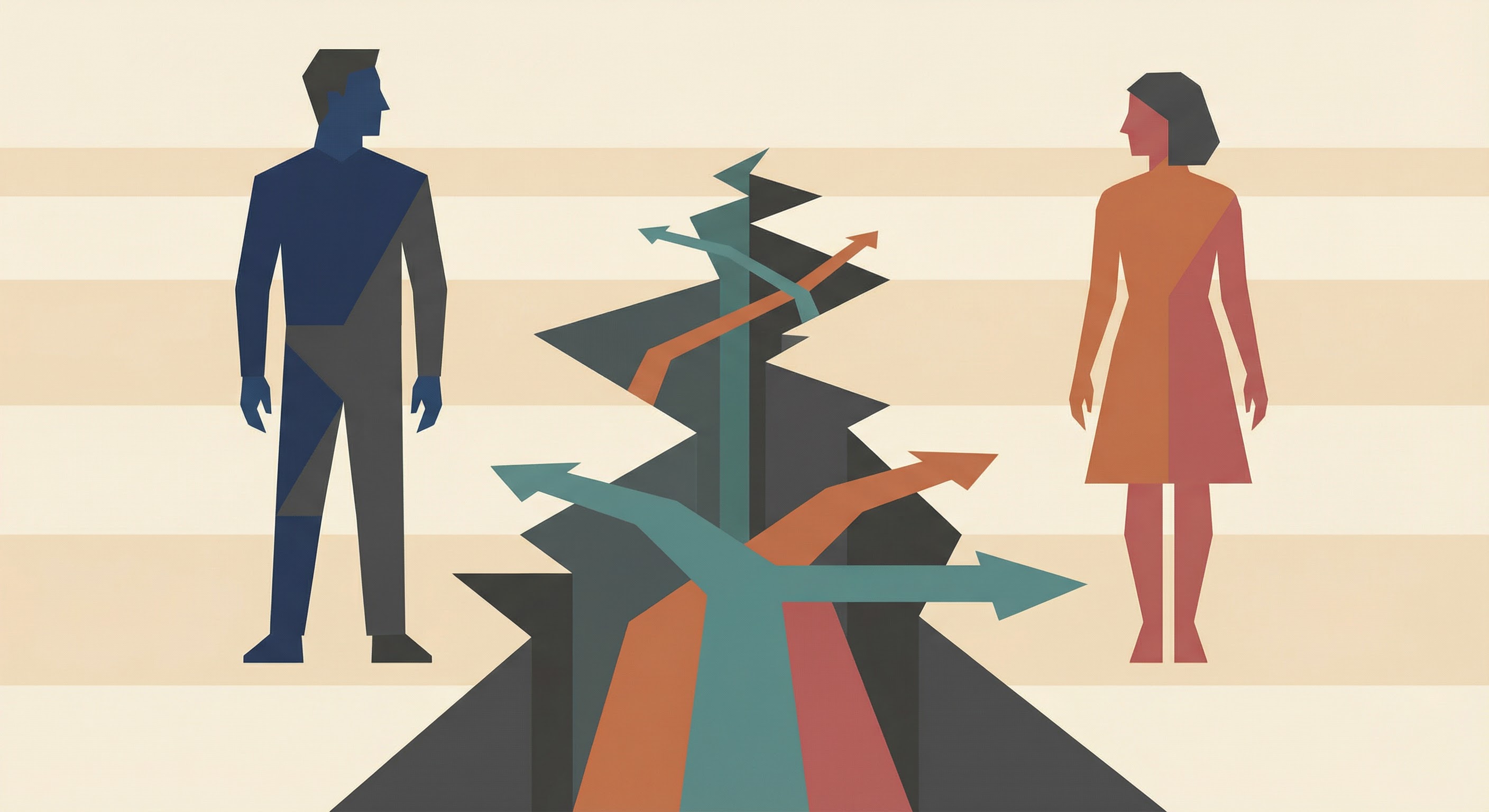
In January 2024, the Financial Times published a set of charts that made the Western world pay attention to something other than artificial intelligence. John Burn-Murdoch had mapped the ideological self-placement of young men and young women across a dozen developed countries from 2000 to 2023. The lines diverged like a pair of scissors opening. In South Korea, the United States, Germany, and the United Kingdom, young women had moved sharply to the left. Young men had stayed where they were — or drifted right. The gap was not a crack. It was a canyon.
The 2024 US presidential election offered the starkest electoral expression. Donald Trump carried men aged eighteen to twenty-nine by roughly thirteen percentage points. Kamala Harris carried women of the same age by an almost identical margin. Among voters under thirty, men and women effectively cancelled each other out — not because both were moderate, but because both were polarised in opposite directions. It was the widest gender gap among young voters in modern American history.
In South Korea, the phenomenon has advanced further than anywhere else on Earth. The 4B movement — bihon (no marriage), bichulsan (no childbirth), biyeonae (no dating), bisekseu (no sex) — has attracted hundreds of thousands of young women who have opted out of heterosexual relationships altogether. South Korea’s total fertility rate fell to 0.72 in 2023, the lowest of any major country in recorded history. Young Korean men, meanwhile, have swung hard toward the anti-feminist People Power Party, propelling Yoon Suk-yeol to the presidency in 2022 on a platform that included abolishing the Ministry of Gender Equality.
For most of human history, men and women disagreed about household chores and whose turn it was to deal with the in-laws. They did not, as a rule, disagree about the fundamental nature of society. That era is over.
The Data
The scale of the divergence is remarkable not for its existence — small gender gaps in political attitude have been measured since at least the 1960s — but for its velocity and breadth.
The Gender-Ideology Gap Among 18–29 Year Olds (1999–2024)
Young women have moved dramatically more liberal while young men have held steady
Source: Gallup Political Ideology surveys (2024); Burn-Murdoch/FT (2024)
In the United States, Gallup’s ideology tracking shows that forty per cent of women aged eighteen to twenty-nine identified as liberal in 2023, compared with twenty-five per cent of men in the same cohort — a fifteen-point gap that has roughly tripled since 2000. Among Americans over fifty, the gender gap is four to six points. The divergence is generational, not biological.
The European Social Survey tells a similar story across the continent. In Germany, young women are thirty percentage points more likely than young men to describe themselves as left-leaning. In the United Kingdom, the gap is twenty-five points. In Sweden — historically one of the most egalitarian societies on Earth — it is twenty-two points. The disagreements cluster around a specific set of issues: gender identity, immigration, social justice, criminal justice, and the relative weight given to individual rights versus collective solidarity. This is a values split, not a conventional left-right economic divide over taxation and spending. It is deeper, more personal, and far harder to bridge.
Richard Reeves, in Of Boys and Men, framed the divergence as structural rather than cultural: young men and young women are responding rationally to fundamentally different lived experiences. Women are outperforming men academically and entering professional careers in historically unprecedented numbers. They have legitimate and extensively documented grievances about harassment, personal safety, and reproductive autonomy — grievances that the #MeToo movement brought into mainstream discourse and that subsequent research has consistently validated. Men without university degrees, meanwhile, are falling behind economically, dying younger from what Anne Case and Angus Deaton have termed “deaths of despair,” and receiving almost no institutional acknowledgement that their difficulties are real.
Both sexes have genuine reasons for discontent. The tragedy is that their discontents point in opposite directions. Women’s grievances are primarily about power, safety, and autonomy. Men’s are primarily about purpose, status, and belonging. These are not competing claims to the same resource. They are orthogonal frustrations — and precisely because they are orthogonal, neither side can easily understand the other’s complaint.
Gender Gap on Key Issues (US Gen Z, 2025)
The divide is widest on social and cultural issues, narrower on economics
Source: The 19th/SurveyMonkey (2025)
Historical Precedents — or the Lack Thereof
The honest answer is that there is no close historical precedent for what is happening now. Gender-based ideological polarisation at this scale, across this many countries simultaneously, is genuinely novel. But there are partial parallels worth examining.
When women first obtained the vote — New Zealand in 1893, Britain partially in 1918, the United States in 1920 — they were, by most measures, more conservative than men. The mass of newly enfranchised women tended to be churchgoing, community-oriented, and wary of radical change. The 1928 British general election, the first held with full female suffrage, produced a Conservative landslide. Anti-suffragists had warned that women’s votes would usher in socialism. History, as is its habit, delivered the opposite. This conservative tendency persisted for decades.
The single most transformative event in the relationship between gender and politics was pharmacological. The approval of the combined oral contraceptive pill in 1960 — and its rapid uptake through the 1960s and 1970s — fundamentally altered women’s economic horizons. Claudia Goldin, who received the Nobel Prize in Economics in 2023 for this work, demonstrated that the pill changed women’s investment horizon: for the first time, they could invest in long professional education — law, medicine, finance — with reasonable confidence that pregnancy would not derail their careers before the investment paid off. The downstream consequences — rising educational attainment, economic independence, later marriage, smaller families, and shifting political priorities — trace back substantially to that small packet of synthetic oestrogen and progestogen.
Something changed around 2012 — visible in the data across multiple countries simultaneously — and it changed differently for each sex. Jonathan Haidt and Jean Twenge have both pointed to the mass adoption of smartphones and social media, particularly among adolescents, as the inflection point. The timing is precise and consistent across the English-speaking world: the divergence accelerates sharply from 2012 to 2013, the period when smartphone penetration among teenagers crossed the fifty per cent threshold. Whether social media caused the divergence or merely accelerated trends already in motion is debated. What is not debated is the correlation.
There is another, less edifying historical pattern worth noting. Societies with large surpluses of unpartnered young men have been, without exception, more violent and more susceptible to authoritarian movements. The current Western divergence is ideological rather than numerical — the sex ratio is roughly balanced — but when large numbers of young men conclude that they have no meaningful stake in the prevailing social order, the consequences are predictable. They vote for disruptors. They retreat into subcultures. Or they turn to violence. Trump, Brexit, Bolsonaro, Meloni, Milei — in each case, the strongest support came disproportionately from men who felt the existing system had left them behind.
Four Structural Drivers
The divergence is not the result of a single cause. It is being driven by four structural forces operating simultaneously, each reinforcing the others.
Education. Women now outperform men academically at every level in the developed world. In the United States, women have earned the majority of bachelor’s degrees since 1982, the majority of master’s degrees since 1987, and the majority of doctorates since 2006. In 2023, women earned 59.5 per cent of all bachelor’s degrees. Universities are not politically neutral environments; the professoriate in the humanities and social sciences leans overwhelmingly left. Students who attend university — increasingly female — are immersed in progressive frameworks for years. Students who do not attend — disproportionately male, working-class — receive no equivalent socialisation. The education system is, inadvertently, a machine for producing ideological divergence.
Social media. TikTok, Instagram, YouTube, and X sort users into parallel information universes with ruthless algorithmic efficiency. A young woman who engages with feminism, social justice, or body-positivity content receives an accelerating stream of similar material. A young man who watches fitness, gaming, or self-improvement content receives a very different stream. Andrew Tate accumulated over 11.6 billion views on TikTok before his arrest; his audience was overwhelmingly male and overwhelmingly young. The algorithms do not create the demand. They amplify and segregate it. Men and women under thirty are, in a literal sense, consuming different media, absorbing different narratives, and forming different pictures of reality.
Tertiary Education Attainment by Sex (OECD Average, 2000–2024)
Women now outperform men at every level of education — a structural driver of the ideological gap
Source: OECD Education at a Glance (2010, 2015, 2020, 2024)
Economic divergence. The traditionally male industries — manufacturing, construction, mining, heavy industry — have eliminated millions of stable, well-paid jobs across the developed world over the past four decades. In the United States, real median earnings for men with only a high school diploma fell twelve per cent between 1979 and 2019. Over the same period, real median earnings for women with a bachelor’s degree rose thirty-three per cent. The economic trajectories have crossed. The “deaths of despair” documented by Anne Case and Angus Deaton — suicide, opioid overdose, alcoholic liver disease — are overwhelmingly male and concentrated among men without university degrees. An entire demographic is falling behind, and the statistical evidence of their suffering is stark.
Institutional asymmetry. The infrastructure for addressing gender disadvantage — government ministries, university programmes, corporate diversity initiatives, scholarships, mentorship networks — is almost exclusively oriented toward women’s advancement. In the United Kingdom there are more than 150 university scholarships reserved for women and precisely zero for men, despite men now comprising only forty-three per cent of university entrants. When Richard Reeves proposed a White House Council on Boys and Men, the response from much of the commentariat ranged from scepticism to open derision. Into this institutional vacuum rushed the influencers. Andrew Tate and Jordan Peterson did not create the demand for male-oriented guidance. They supplied it — crudely, in Tate’s case, and controversially in Peterson’s — because legitimate institutions refused to. The failure is institutional.
Consequences
The consequences of the divergence are already visible in three domains that, together, touch the foundations of democratic society.
Dating and partnership. The share of American men aged eighteen to thirty reporting no sexual partner in the past year rose from ten per cent in 2008 to twenty-seven per cent in 2018. Marriage rates across the developed world are at historic lows. South Korea’s 4B movement is the most radical expression; China’s tang ping (“lying flat”) among young men and Japan’s hikikomori — an estimated 1.5 million predominantly male young adults who have withdrawn entirely from social and economic life — represent the male mirror image. A generation is concluding, on both sides, that the social contract on offer is not worth signing.
Democracy. If men and women increasingly vote as opposing blocs — and the 2024 US election suggests they are — the arithmetic of democratic governance becomes structurally harder. Coalition formation depends on the existence of common ground. When the largest demographic divide runs along the most intimate fault line in society — the relationship between men and women — the scope for compromise narrows dangerously. Legislatures cannot function as arenas of negotiation if the electorate is sorted into two camps that disagree not on policy details but on fundamental values.
Demography. If ideological polarisation is suppressing partnership formation and childbearing — and the evidence from South Korea, Japan, and Southern Europe strongly suggests that it is — the gender divergence is not merely a culture-war talking point. It is a demographic event with civilisational consequences. South Korea’s population will roughly halve by 2100 at its current fertility rate. Japan, Italy, and Spain are on similar trajectories. A society that cannot form partnerships cannot form families, and a society that cannot form families does not have a future.
Where This Ends
The divergence is not a TikTok trend. It is a structural shift driven by forces that show no sign of reversing. Education systems will not spontaneously become less progressive. Algorithms will not spontaneously stop sorting users into ideological silos. The economic divergence between degree-holders and non-degree-holders will not spontaneously close. The institutional asymmetry will not spontaneously correct itself.
The question is whether societies can accommodate the gap without fracturing. Can democratic systems function when the youngest cohort of voters is split along gender lines more deeply than along any other demographic divide? Can birth rates stabilise when the sexes cannot agree on the basic terms of partnership? Can institutions address male disadvantage without being accused of undermining female progress — and can they address female grievances without being accused of ignoring male suffering?
The Finnish researcher Hanna Lahtinen has documented that the divergence in political attitudes between young men and women is wider in the Nordic countries — the most gender-equal societies on Earth by conventional measures — than in less egalitarian nations. This is a finding that should give pause to anyone who believes that the divergence will close as societies become more equal. It may, in fact, be a feature of equality rather than a legacy of inequality.
History suggests that ideological chasms of this magnitude do eventually close. But rarely peacefully, and never quickly. No settlement is yet visible. What is visible is two generations — male and female — each armed with data, each convinced the system is rigged against them, and each increasingly disinclined to listen to the other. The scissors are still opening. Send that to someone who still thinks the gender gap is about who does the dishes.
This article describes what is happening. Its companion — Why the Scissors Opened: Nine Hypotheses for the Gender Ideology Split — asks why.