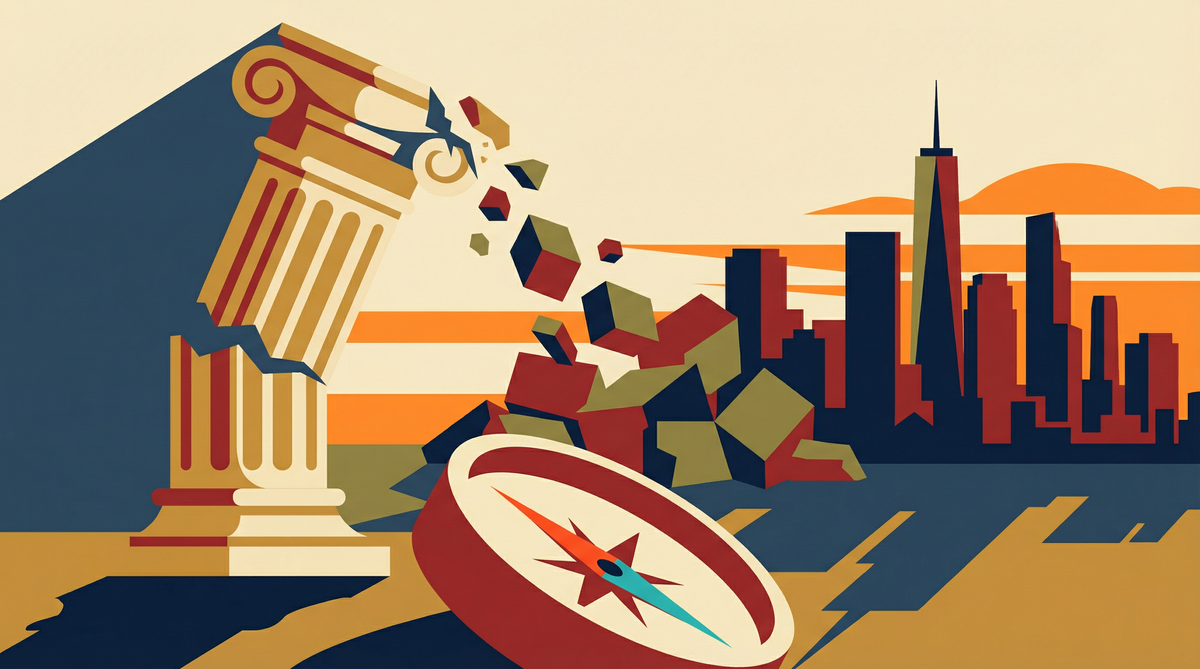
On 20 February 2026, the United States Supreme Court struck down President Trump’s tariffs in a 6–3 ruling. The Court held, in Learning Resources, Inc. v. Trump, that the International Emergency Economic Powers Act does not authorise the President to impose tariffs — a power the Constitution reserves to Congress. Over $175 billion in collected tariff revenue is now subject to potential refunds — more than the combined annual budgets of the Department of Transportation and the Department of Justice. Within hours, the administration signalled it would impose new tariffs under Section 122 of the Trade Act of 1974, with the National Economic Council indicating a 10 per cent global surcharge could be enacted immediately — though limited to 150 days without congressional approval.
The ruling answered a constitutional question: who gets to impose tariffs. The answer — Congress — would have delighted Alexander Hamilton, who designed America’s tariff system in 1791 and built it to run through the legislature deliberately. The Supreme Court just reaffirmed his architecture. But the ruling did not answer the more interesting question: whether tariffs are good for nations. That question was settled centuries ago, by five hundred years of evidence. The answer is yes. And the real scandal is not that a President tried to impose tariffs by executive order. It is that Congress — the body entrusted with this power — spent the last forty years dismantling the very tariff system that built American industry, and now acts surprised when a President tries to rebuild it by other means.
The German economist Friedrich List called it “kicking away the ladder” — climbing to industrial supremacy using protectionist policies and then telling everyone else that ladders were inefficient. The British called it “economic science.” The Japanese called it “administrative guidance.” Everyone else called it what it was: pulling up the drawbridge.
The Pattern: Protect, Grow, Preach
The Tariff Wall and the Rise: Average Tariff Rates During Industrialisation
Every great economy industrialised behind high tariffs — then liberalised once dominant
Source: Bairoch (1993); Irwin (2017); Chang (2002); World Bank historical data
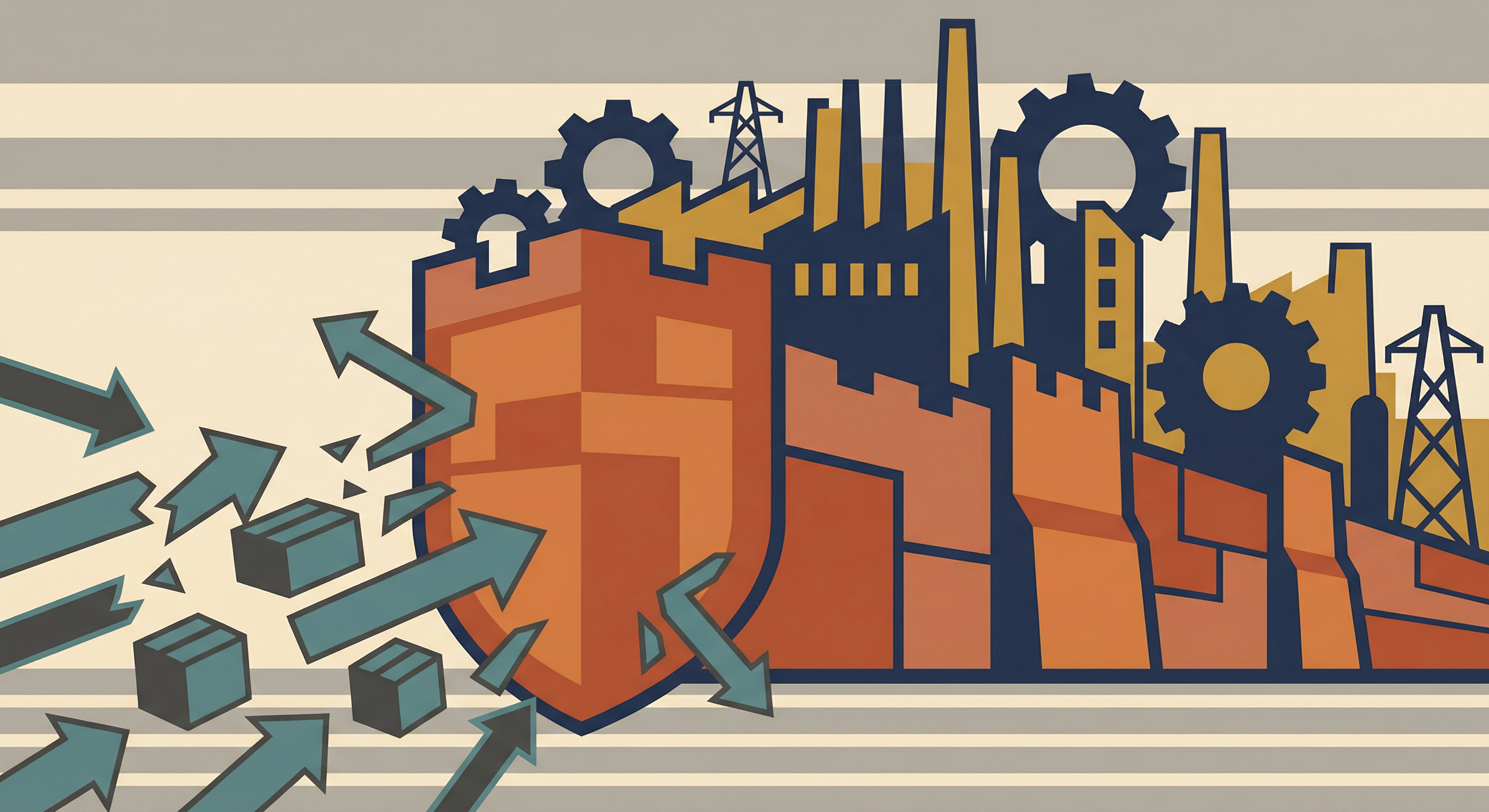
The historical record is not ambiguous. It is unanimous. Every nation that became an industrial power did so behind tariff walls. Every nation that subsequently preached free trade did so after it had achieved dominance — and for the specific purpose of preventing competitors from catching up.
Britain ran a mercantilist empire for three centuries. The Navigation Acts of 1651 required all goods imported to England to be carried on English ships. The Wool Act of 1699 banned the export of finished cloth from Ireland and the American colonies — they could sell raw wool to England but were forbidden from competing with English manufacturers. The Calico Acts of 1700 and 1721 banned the import of Indian cotton cloth, protecting England’s nascent textile industry from the superior Indian product. Britain only became a champion of free trade after the Industrial Revolution had given it manufacturing capabilities that no other nation could match. If you can produce goods that are cheaper, better, and in greater quantities than anyone else, the only thing stopping you from selling everywhere is other countries’ tariff barriers. So you campaign — with gunboats if necessary — to tear those barriers down. Britain did not embrace free trade because Adam Smith persuaded it that competition was virtuous. It embraced free trade because it knew it would win.
The United States was the most protectionist major economy in the world for 150 years. Hamilton’s “Report on Manufactures” of 1791 explicitly rejected Adam Smith and argued that a young nation could not compete against established industrial powers on equal terms. Congress adopted his programme. Average US tariff rates on manufactured goods ranged from 35 to 50 per cent between 1816 and 1945. During this period, the United States went from a marginal agricultural economy to the largest industrial power on Earth. This was not a coincidence. It was the plan. Abraham Lincoln’s Republican Party was the party of high tariffs — and the tariff system they built was the fiscal backbone of the Union war effort and the Gilded Age industrial boom that followed.
Germany unified its internal market through the Zollverein customs union of 1834, then protected that market from British imports while building its industrial base. Friedrich List, who had lived in America and seen Hamilton’s system in action, returned to Germany and made the case for infant-industry protection with devastating clarity. By 1900, Germany was an industrial powerhouse that rivalled Britain. Only then did German industrialists begin to see the appeal of open markets — because they were confident they could compete.
Japan after the Meiji Restoration of 1868 imposed tariffs, directed state investment into strategic industries, and sent engineers abroad to learn — and steal — Western manufacturing techniques. After 1945, MITI (the Ministry of International Trade and Industry) orchestrated one of the most sophisticated protectionist programmes in history, guiding capital into steel, shipbuilding, electronics, and automobiles while keeping foreign competitors out through a web of tariffs, quotas, and administrative barriers. Japan began to liberalise only in the 1980s, after Toyota, Sony, and Panasonic were already global giants.
South Korea under Park Chung-hee in the 1960s and 1970s banned luxury imports outright, imposed sweeping quantitative restrictions on consumer goods, and directed state-controlled credit to the chaebol — Samsung, Hyundai, LG, Daewoo — that the government had selected as national champions. South Korea’s per capita GDP in 1960 was lower than Ghana’s. By the 1990s, it was a top-fifteen economy. It began to liberalise only after its chosen industries were globally competitive. The ladder was kicked away on schedule.
China joined the WTO in 2001 and immediately demonstrated that membership in a free trade institution is no barrier to protectionism. State subsidies to strategic industries ran into the hundreds of billions. Foreign companies were required to form joint ventures with Chinese firms and transfer technology as a condition of market access. Intellectual property was stolen on an industrial scale. The Great Firewall blocked American technology companies from the Chinese market while Chinese alternatives grew behind it. By 2018, China was the world’s largest manufacturer and exporter. It remains, behind the rhetoric, one of the most protectionist economies on Earth.
The pattern is the same in every case: protect, grow, dominate, then preach free trade to prevent others from doing what you just did.
The Hidden Walls
Free Trade in Theory, Protectionism in Practice
Non-tariff barriers by major economy — the gap between rhetoric and reality
Source: World Bank Non-Tariff Measures Database (2023); WTO Trade Policy Reviews
The most insidious form of protectionism is the kind that does not appear in tariff schedules. Non-tariff barriers allow nations to sign free trade agreements with great fanfare while making it practically impossible for foreign goods to compete. The hypocrisy is breathtaking in its scale and its success.
Japan is the master of the invisible wall. Its formal tariff rates are among the lowest in the developed world. But the keiretsu distribution networks — interlocking groups of companies that preferentially buy from one another — function as an informal blockade against foreign goods. Product standards are byzantine and opaque: American car manufacturers found it virtually impossible to obtain certification for the Japanese market, facing redundant safety testing and specifications calibrated to favour domestic designs. Japan only agreed to accept US safety certifications without duplicate local testing in February 2026 — under pressure from tariff negotiations. Government procurement overwhelmingly favours domestic suppliers through specifications written so precisely that only the intended Japanese firm can meet them. The result: Japan has had a persistent trade surplus with nearly every major partner for decades, despite nominally low tariffs.
South Korea deploys a similar toolkit. Regulatory standards are calibrated to favour domestic products. Government-backed “Buy Korean” campaigns cultivate consumer loyalty to domestic brands. Public procurement is effectively closed to foreign firms. The automobile market — in a country that exports millions of cars annually — has a foreign market share of roughly 18 per cent, compared to over 40 per cent in most European countries.
The European Union has elevated non-tariff barriers to an art form. REACH (Registration, Evaluation, Authorisation and Restriction of Chemicals) imposes compliance costs that smaller non-EU exporters cannot absorb. The Common Agricultural Policy subsidises European farmers to the tune of €55 billion per year, making it impossible for developing-world producers to compete on price. The precautionary principle — which requires proof of safety rather than proof of harm — has been deployed to block American agricultural exports, from hormone-treated beef to genetically modified crops, for decades. The EU’s formal position is passionate support for the rules-based international trading order. Its practical position is a fortress of regulation that protects domestic producers as effectively as any tariff wall.
China barely bothers to disguise its barriers. The Great Firewall blocks Google, Facebook, Twitter, YouTube, and most other American technology platforms — a non-tariff barrier worth hundreds of billions to Chinese competitors. State-owned enterprises receive preferential financing, tax treatment, and regulatory support. Government procurement is effectively closed to foreign firms. Joint venture requirements and forced technology transfer persist despite WTO commitments to phase them out.
The nations that shout loudest about free trade are frequently the ones practising the most sophisticated protectionism. They have simply moved the walls from the customs house to the standards agency, the procurement office, and the regulatory commission.
There is a theoretical escape from all of this. Free trade economists — Milton Friedman most eloquently among them — argue that floating exchange rates are the self-correcting mechanism that makes tariffs unnecessary. If one country can produce everything more cheaply, its currency will appreciate until trade balances. The logic is impeccable. The evidence is non-existent. China pegged the yuan to the dollar for decades, maintaining an artificial export advantage that no market mechanism was permitted to correct. Japan intervened relentlessly in currency markets throughout the 1980s and 1990s. The eurozone prevents individual member states from adjusting their exchange rates at all — Greece cannot devalue against Germany, which is one reason Greek industry was obliterated after joining the euro. The United States has run a trade deficit every single year since 1976 — nearly fifty years of a self-correcting mechanism that has yet to correct. Even when exchange rates do eventually shift, the adjustment arrives decades after the damage is done. A factory that closes in year one does not reopen in year ten when the currency has moved. The workers have dispersed, the skills have atrophied, the supply chains have relocated. The exchange rate thermostat works on a thirty-year delay in a house that needed heating today.
The Great Sacrifice
The Cost of Generosity: US Trade Balance 1945–2025
From post-war surplus to chronic deficit — the price of opening America's markets
Source: US Bureau of Economic Analysis; Federal Reserve Economic Data (FRED)
The most extraordinary chapter in the history of trade policy is one that most economists prefer to skip. After the Second World War, the United States found itself in a position that no nation had occupied since Rome at its zenith: it was the only major industrial economy left standing. Europe was rubble. Japan was rubble. The Soviet Union had won at a cost of 27 million dead and an industrial base pulverised west of the Urals. China was entering a civil war. Britain was bankrupt.
American factories, untouched by bombing, were producing half of the world’s manufactured goods. American technology was unmatched. American infrastructure was intact. In 1945, the United States ran a trade surplus with virtually every country on Earth — because no other country could make goods as cheaply, as reliably, or in such quantity. America could have dominated global trade for generations. It had an absolute advantage in nearly every sector. Every other major economy would have had to buy American, because there was nothing else to buy.
Instead, the United States made a strategic choice that would have baffled Hamilton and appalled List. It opened its markets to allies — and tolerated, even encouraged, their protectionism against American goods. The Marshall Plan poured $13.3 billion (over $150 billion in today’s money) into rebuilding the very European economies that would soon compete with American manufacturers. The General Agreement on Tariffs and Trade progressively lowered American tariff barriers while accepting that allies would lower theirs more slowly, or not at all. Japan was permitted to wall off its domestic market with quotas, tariffs, and administrative barriers while Japanese cars and electronics flooded American showrooms. West Germany’s Wirtschaftswunder was built behind protectionist walls that kept American goods out while German exports entered the US with minimal friction. South Korea and Taiwan were allowed to run mercantilist industrial policies — directing state credit, imposing high tariffs, restricting foreign investment — because they hosted American military bases on the Soviet and Chinese borders.
The United States did not need these countries’ markets. It needed their geography and their loyalty. Open access to the American market was the currency Washington paid for Cold War allegiance. It was the most expensive geopolitical subsidy in history — and it worked. The Western bloc held. The Soviet Union collapsed. The Cold War was won.
But the price was staggering. By the 1980s, the industrial base that had won the Second World War was hollowing out. American manufacturing employment peaked at 19.6 million in 1979. By 2010, it had fallen to 11.5 million. The United States ran its first postwar trade deficit in 1971. By 1976, the deficits had become permanent — and they have remained so ever since. The Rust Belt — once the arsenal of democracy — became a graveyard of closed factories, abandoned towns, and broken communities. The human cost of that geopolitical generosity was borne by the workers of Ohio, Michigan, Pennsylvania, and Indiana, who lost their livelihoods so that Washington could win a global chess match.
The cruelty of the bargain is that it was never explained to the people who paid for it. No President stood before the workers of Detroit and said: “We are going to let Japan and Germany sell their goods here while they block ours, because we need their governments on our side against Moscow.” The sacrifice was real. The honesty was not.
The Lesson
The evidence of five centuries points in one direction. Tariffs are not an aberration. They are the norm. Free trade is the aberration — a brief period, roughly 1980 to 2015, during which one group of nations was so dominant that it could afford to pretend the rules did not apply. The rules always applied. They just took forty years to reassert themselves.
Every nation that industrialised did so behind tariff walls. Every nation that preached free trade did so from a position of dominance, for the specific purpose of preventing others from industrialising. Every nation that believed the dominant power’s sermon and opened its markets prematurely either failed to develop or watched its existing industries wither. The theory of comparative advantage — Ricardo’s elegant idea that nations should specialise in what they do best — works beautifully in textbooks and disastrously in practice, because it assumes that what a nation “does best” is fixed. It is not. What a nation does best is determined by what it chooses to invest in, protect, and develop. South Korea’s comparative advantage in 1960 was rice farming. Its comparative advantage in 2025 is semiconductors. That transformation did not happen because South Korea embraced free trade. It happened because South Korea rejected it.
Free trade advocates warn that tariffs invite retaliation — “competition in masochism and sadism,” as Friedman put it. They are right about retaliatory tariffs: tit-for-tat duties imposed in anger, without strategic purpose, as political gestures. Smoot-Hawley was retaliatory, and the consequences were severe. But strategic tariffs — imposed not as punishment but as industrial policy, to build domestic capability in sectors that do not yet exist or that have atrophied — are a different instrument entirely. Hamilton’s tariffs were not retaliation against Britain. They were construction. South Korea’s tariffs were not retaliation against Japan. They were incubation. Japan’s MITI-guided quotas were not punishment of foreign firms. They were the scaffolding around which Toyota and Sony were built. The tariffs that built industrial powers were strategic, targeted, and conditional on performance: if you did not export, you lost the subsidy. The tariffs that caused damage were the blunt, indiscriminate, politically motivated ones that free trade economists rightly criticise. The distinction matters, and the failure to draw it is the central sleight of hand in the free trade argument.
The Supreme Court ruled today that tariffs are Congress’s business. Hamilton would have agreed. He would also have asked why Congress abdicated that business for four decades, allowing the industrial base he spent his career building to be shipped overseas in the name of an economic theory that every successful nation in history — including the one Hamilton built — had proved wrong.
The moral case for unilateral free trade — “we believe in freedom and intend to practise it,” as Milton Friedman urged — sounds noble. But a nation that has outsourced its industrial base to a strategic rival has not practised freedom. It has practised dependency — the national equivalent of living on someone else’s credit card. Freedom requires sovereignty, and sovereignty requires the capacity to make the things a nation needs.
The nations that understood this are the ones that prospered. The nations that believed the lie are the ones still waiting for comparative advantage to deliver the prosperity they were promised. The ladder is there for anyone willing to climb it. But only a fool kicks it away before reaching the top — and only a greater fool never picks it up at all.
Protect and Grow: US Manufacturing Employment 1940–2025
The hollowing out of American industry after the shift to free trade
Source: Bureau of Labor Statistics; Federal Reserve Economic Data (FRED)