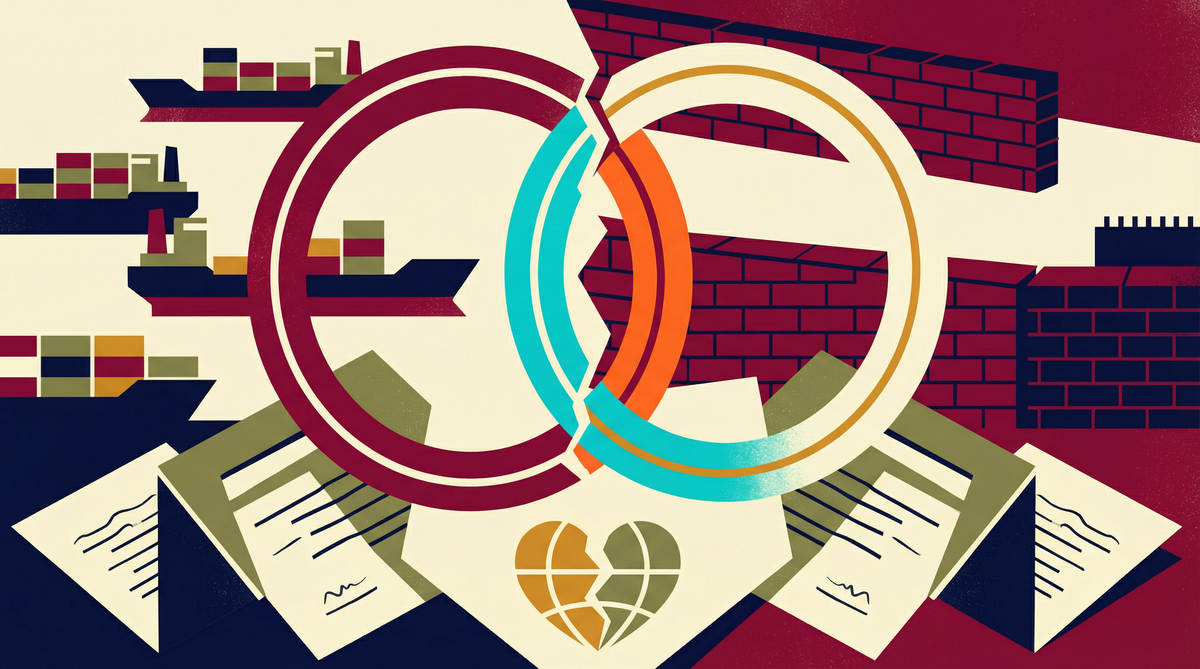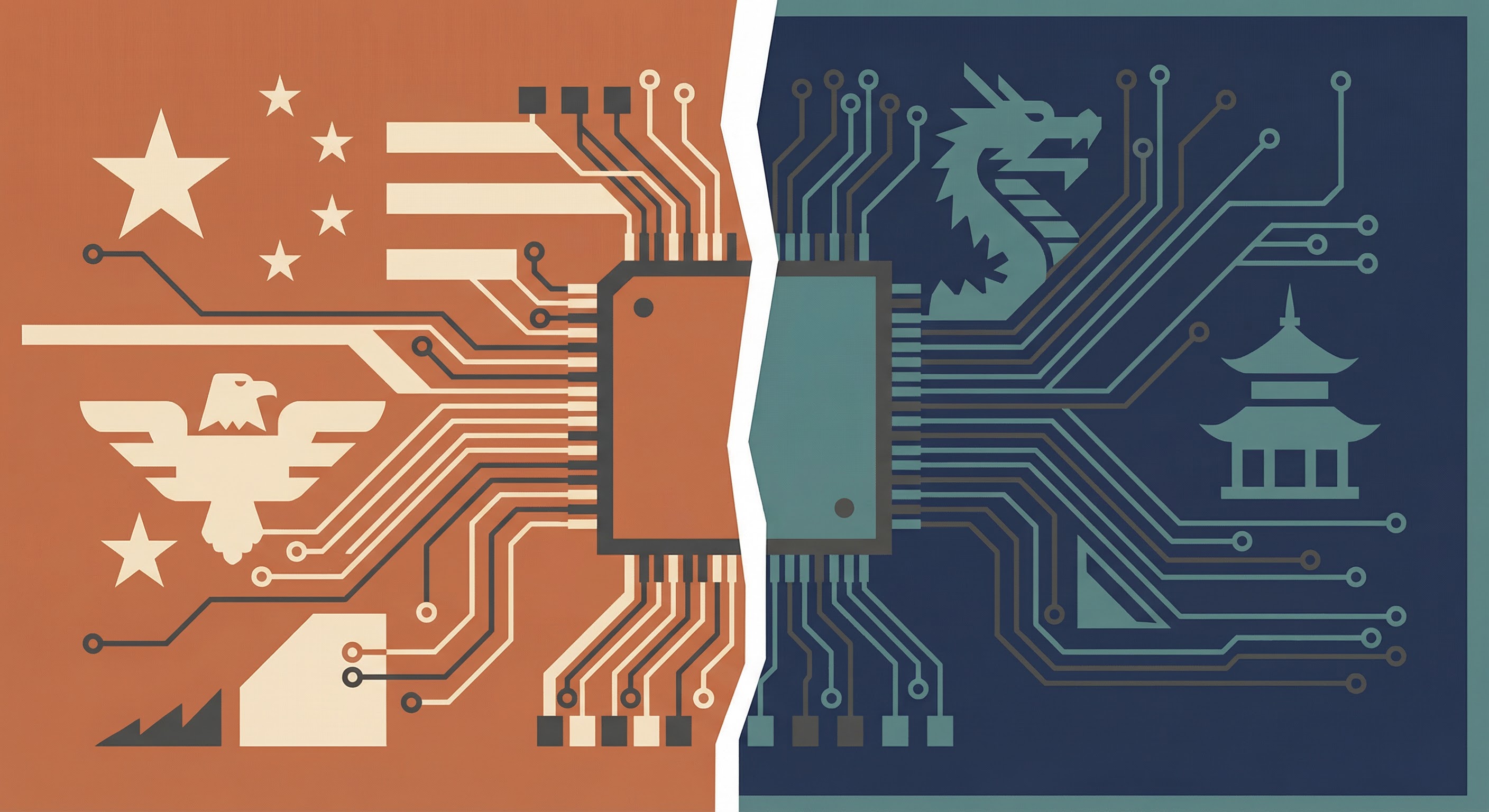
On 7 October 2022, the United States Bureau of Industry and Security published a set of export controls that amounted, in diplomatic dress, to economic warfare. The regulations did not merely restrict the sale of advanced semiconductors to China. They banned American citizens and permanent residents from working for Chinese chip companies. They prohibited the export of any equipment capable of manufacturing chips below fourteen nanometres. They extended these restrictions extraterritorially, pressuring the Netherlands and Japan — home to ASML and Tokyo Electron, the two most critical equipment suppliers after the US — to impose matching controls. In a single regulatory action, the United States had attempted to freeze the technological development of 1.4 billion people. Jake Sullivan, the National Security Advisor, was unusually candid about the objective: the goal was not to maintain America’s lead in advanced computing, but to widen it. This was not competition. It was containment.
The immediate target sat in a science park in Hsinchu, Taiwan. Taiwan Semiconductor Manufacturing Company — TSMC — fabricates roughly ninety per cent of the world’s most advanced logic chips: the processors that power artificial intelligence, advanced weapons systems, and the critical digital infrastructure of every major economy. One company, on an island of twenty-three million people, located 130 kilometres from a nuclear-armed superpower that claims sovereign authority over it, produces the component without which neither the American nor the Chinese economy can function. This is not a supply chain. It is a single point of catastrophic failure dressed up as globalisation. The Cold War divided the world into two blocs with different economic systems. The tech war is dividing it into two blocs with different search engines. The stakes may actually be higher — an economic system can be reformed in a generation; a technological ecosystem, once built and embedded in standards, training, and infrastructure, is vastly harder to uproot.
Why Semiconductors Are the New Oil
The twentieth century was shaped by hydrocarbons. The twenty-first will be shaped by semiconductors. Oil mattered because it fuelled industry and war; the nations that controlled it held decisive strategic advantage, and those that depended on others for supply discovered, repeatedly, what that dependency cost. Semiconductors occupy an analogous position, but the supply chain is far more concentrated.
Advanced logic chips at the seven-nanometre node and below are manufactured by exactly three companies: TSMC, Samsung, and Intel. The machinery required to make them — specifically, extreme ultraviolet lithography systems — is produced by precisely one: ASML, in Veldhoven, the Netherlands. ASML holds a complete global monopoly on EUV lithography. Each machine costs roughly $380 million, weighs over 150 tonnes, and takes over a year to assemble from components sourced in dozens of countries. There is no alternative supplier. There is no near-term prospect of one. As Chris Miller documents in Chip War, every advanced chip on Earth passes through a supply chain that could fit inside a mid-sized European town.
The historical parallel is instructive. During the Second World War, Sweden’s SKF company supplied precision ball bearings to both the Allies and the Axis. Ball bearings were essential to aircraft engines, tanks, and artillery — small, unglamorous components without which the most advanced weapons were scrap metal. Albert Speer, Hitler’s armaments minister, told his Allied interrogators after the war that sustained bombing of Germany’s ball bearing plants at Schweinfurt might have shortened the conflict by months. The US Eighth Air Force lost over a hundred B-17 bombers in two raids on Schweinfurt in 1943 — seventy-seven on Black Thursday alone — among the costliest air operations of the entire European theatre. The lesson was expensive and clear: whoever controls the chokepoint controls the contest. TSMC, ASML, and a handful of chemical suppliers are the Schweinfurt of the twenty-first century.
Global Semiconductor Market Share by Region (2024)
A handful of chokepoints control the world's most critical technology
Source: SIA; Gartner; ASML Annual Report 2024
The concentration is not merely geographical but temporal. A single EUV lithography machine takes over a year to build and another year to install, calibrate, and bring to full production yield. If ASML’s facility in Veldhoven were destroyed by fire, flood, or sabotage — or if a conflict in the Taiwan Strait disrupted TSMC’s fabs — the global semiconductor supply would face a disruption measured not in weeks but in years. No advanced smartphone, no AI training run, no modern weapons system could be manufactured at scale. The world economy would seize.
Both sides are now building redundancy, with an urgency that suggests both understand the fragility. The United States has committed $52 billion to domestic semiconductor manufacturing under the CHIPS and Science Act. TSMC is building fabs in Arizona; Samsung in Texas; Intel in Ohio. China has poured over $150 billion into its domestic chip industry since 2014. In August 2023, Huawei unveiled the Mate 60 Pro, powered by a Kirin 9000S chip manufactured by SMIC at the seven-nanometre node — demonstrating that American export controls had slowed Chinese progress but had not stopped it. The race to secure redundant semiconductor capacity is the most consequential industrial competition since the nuclear arms race. It is less photogenic and receives a fraction of the attention.
When Technology Has Split Before
The splitting of a unified technological civilisation into two parallel systems has happened before. The consequences have always been profound, and they have never been reversible.
Rome and Persia maintained rival engineering traditions, military technologies, and administrative systems for the better part of seven centuries. Trade existed across the frontier; technology transfer was minimal. Each empire developed independently — Roman concrete and aqueducts on one side, Persian irrigation systems and centralised bureaucracy on the other. What ultimately destroyed both was exhaustion: by the time the Arab armies emerged from the Arabian Peninsula in the 630s, Rome and Persia had spent themselves in a ruinous final war from 602 to 628. The Arabs, who had absorbed techniques and ideas from both civilisations without being locked into either, conquered Persia entirely and stripped Rome of Egypt, Syria, and Palestine within two decades. Parallel systems created parallel vulnerabilities — and a nimble third party exploited both.
The Cold War is the modern precedent. The Soviet Union built separate computing, aerospace, telecommunications, and industrial standards from scratch. Soviet engineers were often brilliant; the Soyuz rocket still flies, and Soviet mathematics departments produced some of the finest minds of the twentieth century. But the separated system fell behind. Without access to Western competitive pressures, venture capital, and the creative destruction of market economies, Soviet technology became progressively less innovative. The IBM PC emerged from a competitive American market; the Soviet equivalent, the ES series, was essentially a reverse-engineered copy, perpetually a generation behind. By 1985, the gap between Western and Soviet computing was an unbridgeable chasm. The Soviet system did not reform. It collapsed — and the cost of reintegrating Eastern European technology with Western standards consumed over two trillion euros in Germany alone and took decades.
A subtler precedent deserves attention: the Protestant-Catholic schism of the sixteenth century created two distinct knowledge ecosystems in Europe. Protestant nations — the Dutch Republic, England, the Nordic countries — developed cultures of open publication, empirical enquiry, and intellectual competition. Catholic nations maintained the Inquisition and the Index of Forbidden Books. Galileo was silenced; Copernicus was banned. Spain, the wealthiest nation in Europe in 1500, was a declining backwater by 1700. The Dutch Republic, with a fraction of Spain’s population and none of its gold, became the richest society in Europe per capita. The nations that controlled the flow of information controlled the future. China’s Great Firewall is the modern Index: it maintains political stability but imposes a cumulative innovation tax whose full cost will only become apparent over decades.
Two Stacks, Two Worlds
The bifurcation is already visible across every major technology layer.
In artificial intelligence, the Western ecosystem runs on OpenAI, Google DeepMind, Anthropic, and Meta. China’s runs on Baidu, Alibaba, Tencent, and DeepSeek — which, in January 2025, released a model that matched frontier American performance at a fraction of the reported training cost. The two ecosystems are trained on different data, governed by different regulations, and optimised for different values. They are not interoperable.
In social media, the Western stack — Instagram, Facebook, YouTube, X — has no presence in China. The Chinese stack — WeChat, Weibo, Douyin, Xiaohongshu — has no presence in the West, with the contested exception of TikTok, whose ownership and data practices remain the subject of ongoing American legislative action. In payments, Visa and Mastercard dominate the Western world; China’s UnionPay has roughly seven billion cards in circulation, and Alipay and WeChat Pay process more mobile transactions than every Western payment platform combined. In telecommunications, the West has committed to Ericsson and Nokia for 5G infrastructure; much of Africa, Southeast Asia, and Latin America has chosen Huawei — which is cheaper, often more technically advanced, and comes without conditions about governance or human rights. In cloud computing, Amazon Web Services, Microsoft Azure, and Google Cloud dominate the Western world; Alibaba Cloud, Tencent Cloud, and Huawei Cloud are building competing infrastructure across the Global South. In satellite navigation, the West relies on GPS; China has deployed BeiDou, which now has more satellites in orbit and offers greater accuracy in the Asia-Pacific region.
The Five Eyes nations, the EU, Japan, South Korea, and Taiwan are firmly in the American stack. China, Russia, Iran, and North Korea are in the Chinese stack. The consequential middle — India, the Gulf states, Southeast Asia, Africa, Brazil, Indonesia — is attempting to straddle both. India uses American weapons and Russian oil, hosts Google’s largest office outside the US and Huawei’s largest research centre outside China, and participates in both the Quad and BRICS. That ambiguity has been profitable, but it cannot last indefinitely. As standards diverge and data increasingly cannot flow between ecosystems, the non-aligned middle will narrow. Every nation will eventually be forced to choose which technological civilisation to join — or to accept the costs of maintaining compatibility with both.
Who Wins — and the Continental System Risk
The open system wins. It wins reliably, and it wins over the long run. Athens outlasted Sparta — not on the battlefield, where Sparta prevailed, but in the contest of culture, commerce, and intellectual dynamism that defined the classical world for centuries after both cities’ military power had faded. The Protestant North overtook the Catholic South. The West buried the Soviet bloc. In every historical case, the system that permitted more internal competition, tolerated more failure, and allowed more bottom-up innovation produced more durable power than the system that directed from the centre.
China’s state-directed system has produced remarkable results: the world’s largest high-speed rail network, globally competitive 5G, electric vehicles that are outcompeting Western manufacturers on price, and a solar manufacturing base that dominates the planet. But mobilisation is not the same thing as innovation. The Soviet Union mobilised brilliantly — it built nuclear weapons within four years of Hiroshima and put a man in space before the Americans. Then it stopped, because centralised systems are superb at catching up to a defined technological frontier but structurally poor at pushing beyond it. Innovation requires the tolerance of failure, the decentralisation of decision-making, and the creative destruction of existing players by new ones — all of which are features of market democracies and threats to authoritarian control.
The Bifurcation: US-Aligned vs. China-Aligned Technology Stacks
Two parallel technology ecosystems are emerging across every layer of the stack
Source: Rhodium Group; Eurasia Group; author analysis
America’s greatest risk is not that China will out-innovate it. It is that Washington will overplay its hand. In 1806, Napoleon imposed the Continental System to destroy British trade by closing Europe’s ports to British goods. The effect was the opposite: British trade globalised, finding new markets in Latin America and Asia; continental Europe suffered shortages and resented the blockade that caused them. The October 2022 semiconductor controls are America’s Continental System. If they succeed in crippling China’s chip industry, they achieve a genuinely historic strategic objective. If they merely accelerate China’s drive towards an independent supply chain while alienating the nations forced to choose sides, they hand China something it could not have built alone: the political mandate to decouple completely.
ASML’s sales to China represented roughly twenty-nine per cent of its revenue in 2023. The Dutch did not sever that relationship willingly. Every nation forced to choose a side in the tech war will remember being forced. The resentment the non-aligned movement expressed during the Cold War — we are customers, not vassals — is already resurfacing.
The Tech Bloc Map: US-Aligned, China-Aligned, and Non-Aligned (2025)
Every nation is being pulled towards one tech ecosystem — some are trying to straddle both
Source: Author analysis based on 5G deployment, AI partnerships, and payment system adoption
The Severed Circuit
The circuit, once severed, cannot easily be reconnected. The Soviet Union demonstrated this when it collapsed: decades of separate technical standards meant Soviet industry could not plug into the Western economy without wholesale replacement. East Germany, despite over two trillion euros in transfer payments since reunification, still lags West Germany in productivity and wages. Technical divergence creates institutional divergence; institutional divergence creates cultural divergence; cultural divergence creates political divergence. Standards shape habits; habits shape expectations; expectations shape identity. Beyond a certain point, the process is irreversible.
The great technology bifurcations of the past — Rome and Persia, Catholicism and Protestantism, the West and the Soviet Union — all ended with the collapse of one system and its absorption into the other. There is no historical precedent for two incompatible technological civilisations peacefully merging. One system wins; the other is dismantled. The question is which — and at what cost to the nations caught in between, who will bear the consequences of a bifurcation they did not choose and cannot control.
The world is dividing into two technological civilisations. Both will function. Both will innovate. They will not be compatible, and they will not be peacefully reunited. The nations that choose wisely will prosper; those that choose badly, or fail to choose at all, will find the choice has been made for them. Send that to someone who still thinks the tech war is just a trade dispute.